Here are all the things I (probably) didn't say in my Chair's welcome for the Museums Computer Group annual conference... Other notes, images and tweets from the day are linked from 'UKMW14 round-up: posts, tweets, slides and images'.
Welcome to MCG's UKMW14: Museums beyond the web! We've got great speakers lined up, and we've built in lots of time to catch up and get to know your peers, so we hope you'll enjoy the day.
It's ten years since the MCG's Museums on the Web became an annual event, and it's 13 years since it was first run in 2001. It feels like a lot has changed since then, but, while the future is very definitely here, it's also definitely not evenly distributed across the museum sector. It's also an interesting moment for the conference, as 'the web' has broadened to include 'digital', which in turn spans giant distribution networks and tiny wearable devices. 'The web' has become a slightly out-dated shorthand term for 'audience-facing technologies'.
When looking back over the last ten years of programmes, I found myself thinking about planetary orbits. Small planets closest to the sun whizz around quickly, while the big gas giants move incredibly slowly. If technology start-ups are like Mercury, completing a year in just 88 Earth days, and our audiences are firmly on Earth time, museum time might be a bit closer to Mars, taking two Earth years for each Mars year, or sometimes even Jupiter, completing a circuit once every twelve years or so.
But museums aren't planets, so I can only push that metaphor so far. Different sections of a museum move at different speeds. While heroic front of house staff can observe changes in audience behaviours on a daily basis and social media platforms can be adopted overnight, websites might be redesigned every few years, but galleries are only updated every few decades (if you're lucky). For a long time it felt like museums were using digital platforms to broadcast at audiences without really addressing the challenges of dialogue or collaborating with external experts.
But at this point, it seems that, finally, working on digital platforms like the web has pushed museums to change how they work. On a personal level, the need for specific technical skills hasn't changed, but more content, education and design jobs work across platforms, are consciously 'multi-channel' and audience rather than platform-centred in their focus. Web teams seem to be settling into public engagement, education, marketing etc departments as the idea of a 'digital' department slowly becomes an oxymoron. Frameworks from software development are slowly permeating organisations that use to think in terms of print runs and physical gallery construction. Short rounds of agile development are replacing the 'build and abandon after launch' model, voices from a range of departments are replacing the disembodied expert voice, and catalogues are becoming publications that change over time.
While many of us here are comfortable with these webby methods, how will we manage the need to act as translators between digital and museums while understanding the impact of new technologies? And how can we help those who are struggling to keep up, particularly with the impact of the cuts?
Today is a chance to think about the technologies that will shape the museums of the future. What will audiences want from us? Where will they go looking for information and expertise, and how much of that information and expertise should be provided by museums? How can museums best provide access to their collections and knowledge over the next five, ten years?
We're grateful to our sponsors, particularly as their support helps keep ticket prices affordable. Firstly I'd like to thank our venue sponsors, the Natural History Museum. Secondly, I'd like to thank Faversham & Moss for their sponsorship of this conference. Go chat to them and find out more about their work!
Showing posts with label Museums Computer Group. Show all posts
Showing posts with label Museums Computer Group. Show all posts
Friday, 7 November 2014
Sunday, 15 June 2014
What are the hidden costs when you attend an event?
I think quite hard about how to make Museums Computer Groups events as inclusive as possible, from the diversity of the speakers on stage, to setting dates and times as early as possible to allow cheaper pre-booked travel, to keeping event costs down and more, but there's always more to learn.
I've been thinking about the 'shadow' or hidden costs accrued when people attend events. For me, it's the cost of getting to London (up to £50 if it's at short notice) and the time it takes (up to 3 hours each way if I'm unlucky). For others, accessibility requirements add to the cost of events, whether that's sign language translators, taxis to accessible train stations, or someone else's time as an aide. For parents or people with other caring responsibilities, childcare costs may add to the expense of attending an event. This in turn affects our ability to put together a broad range of speakers for an event. So -
Here are some responses to get you started - with thanks to those who've already shared their costs:
Update - more responses below.
I'd been thinking of single-day events and the impact on speaker availability, but I was reminded of the impact of childcare and other responsibilities for people wanting to attend residential programmes or longer events (or day events that require an overnight stay to fit the travel in). For example:
* I'm experimenting with typeform but already I'm concerned that their forms don't seem accessible - how are they for you?
I've been thinking about the 'shadow' or hidden costs accrued when people attend events. For me, it's the cost of getting to London (up to £50 if it's at short notice) and the time it takes (up to 3 hours each way if I'm unlucky). For others, accessibility requirements add to the cost of events, whether that's sign language translators, taxis to accessible train stations, or someone else's time as an aide. For parents or people with other caring responsibilities, childcare costs may add to the expense of attending an event. This in turn affects our ability to put together a broad range of speakers for an event. So -
Hello parents in the UK! I'm thinking about hidden costs for speakers turning up to an event. How much does a day's childcare cost you?
— Mia (@mia_out) June 15, 2014
I'm asking parents in the UK for a rough estimate of childcare costs for a day. You can share yours by tweeting @mia_out or share anonymously via this form if 140 characters won't allow you to mention things like your location, number and age of kids: What are the hidden costs when you attend an event?* The second question on the form is more general, so if your costs have nothing to do with parenting, go for it! I'll share the answers so that other event organisers have a sense of the costs too.Here are some responses to get you started - with thanks to those who've already shared their costs:
@otfrom @mia_out @JeniT £12 / hr for 2. A full day is usually 100 plus. Quite difficult to justify often esp w/ travel.
— Yodit Stanton (@yoditstanton) June 15, 2014
about £40 a day in the West Midlands.
— Andrew Fray (@tenpn) June 15, 2014
@mia_out childcare is £3/hr for a 5 year old. Was 330/mth as a child for 5 hrs a day.
— Mick Brennan (@lightzenton) June 15, 2014
We're a volunteer Committee rather than professional events organisers, and there's a humbling amount to learn from people out there. What hidden costs have I missed? Are there factors apart from cost that we should consider? We've got a Call for Papers for November 7's UKMW14: Museums Beyond the Web open at the moment (until June 30, 2014) - is there any language on that CfP or our Guidance for Speakers we should look at?Update - more responses below.
@mia_out assuming you can actually find a reliable (qualified?) babysitter for a whole day or two, then min. wage c£6 per hour at very least
— Internet Archaeology (@IntarchEditor) June 15, 2014
@mia_out nursery (under 5s) costs might be between £30-50 per day but of course they won't do weekends
— Internet Archaeology (@IntarchEditor) June 15, 2014
@mia_out day would cost us £90 or so, but not always poss; last conf my wife presented at I took leave and came along to look after babies.
— Jakob Whitfield (@thrustvector) June 15, 2014
@mia_out @otfrom Nurseries in East Dulwich vary, but since they're all oversubscribed 1500/month isn't outrageous.
— JulianBirch (@JulianBirch) June 15, 2014
@mia_out That's 8-6 including meals. Costs typically go down after age 2.But plenty of people can't find childcare at all and give up work.
— JulianBirch (@JulianBirch) June 15, 2014
@mia_out About £50 a day. We’re lucky in that our nursery will usually have space if we need an extra day.
— suzicatherine (@suzicatherine) June 15, 2014
The daily childcare costs (£40 pc,pd) are usually factored into a working day @mia_out The early drop off and/or late pick up can be tricky!
— Kathryn Eccles (@KathrynEccles) June 15, 2014
I'd been thinking of single-day events and the impact on speaker availability, but I was reminded of the impact of childcare and other responsibilities for people wanting to attend residential programmes or longer events (or day events that require an overnight stay to fit the travel in). For example:
@mia_out can't bring pets to conf., and dog walkers are not cheap #hiddencost
— Scott (@moltude) June 16, 2014
The ability to attend residential events for career or research fellowships is obviously going to have an impact on the types of people we see in leadership positions in later years, so thinking about things like childcare (which might be as simple as providing space for someone who already helps look after the family) now would make a positive difference later. On the positive side, many fellowships provide honorariums, which could help cover the hidden costs many of you have shared with me.* I'm experimenting with typeform but already I'm concerned that their forms don't seem accessible - how are they for you?
Thursday, 21 November 2013
Collaboration, constraints and cloning and 'the open museum': notes from UKMW13
MCG's UK Museums on the Web 2013: 'Power to the people' was held at Tate Modern on November 15, 2013. These are very selected notes but you can find out more about the sessions and see most slides on the MCG's site. UKMW13 began with a welcome from me (zzz) and from Tate's John Stack (hoorah!) then an announcement from our sponsors, Axiell Adlib and CALM, that CALM, Mimsy and AdLib are merging to create 'next generation' collections system - the old school collections management geek in me is really curious to see what that means for museums, libraries and archives and their data.
Our first keynote, Hannah Freeman, presented on the Guardian's work to reach and engage new audiences. This work is underpinned by editor Alan Rusbridger's vision for 'open journalism':
The Guardian is actively looking for ways to involve the audience; Freeman prompts editors and authors to look at interesting comments, but 'following as well as leading is a challenge for journalists'. She said that 'publication can be the beginning, not the end of the process' and that taking part in the conversation generated is now part of the deal when writing for the Guardian (possibly not all sections, and possibly staff journalists rather than freelancers?). From a reader's point of view, this is brilliant, but it raises questions about how that extra time is accounted for. Translating this into the museum sector and assuming that extra resources aren't going to appear, if you ask curators to blog or tweet, what other work do you want them to give up?
Our closing keynote, the Science Gallery's Michael John Gorman was equally impressive. Dublin's Science Gallery has many constraints - a small space, no permanent collection, very little government funding, but he seems to be one of those people who sees interesting problems to solve where other people see barriers. The Science Gallery acts as funnel for ideas, from an open call for shows to some people working on their ideas as a 'brains trust' with the gallery and eventually a few ideas making it through the funnel and onto the gallery floor to incubate and get feedback from the public. Their projects have a sense of 'real science' about them - some have an afterlife in publications or further projects, some might go horribly wrong or just not work. I can't wait until their gallery opens in London so I can check out some of their shows and see how they translate real scientific questions into interesting participatory experiences. Thinking back over the day, organisations like the Science Gallery might be the museum world's version of open journalism: the Science Gallery's 'funnel' is one way of putting the principles of the 'open museum' into practice (I've copied the Guardian's 10 principles of open journalism below for reference).
The open museum isn't necessarily tied to technology, though the affordances of digital platforms are clearly related, but perhaps its association with technology is one reason senior managers are reluctant to engage fully with digital methods?
A related question that arose from Hannah's talk - are museums now in the media business, like it or not? And if our audiences expect museums to be media providers, how do we manage those expectations? (For an alternative model, read David Weinberger's Library as Platform.)
Another big theme was a reminder of how much is possible when you have technical expertise on hand to translate all the brilliant ideas museums have into prototypes or full products. At one point I jokingly tweeted that the museum and heritage sector would make huge leaps if we could just clone Jim O'Donnell (or the BBC's R&D staff). Perhaps part of the 'museums are digitally innovative'/'museums suck at digital' paradox is that technologists can see the potential of projects and assume that a new standard has been set, but it takes a lot more time and work to get them integrated into mainstream museum practice. Part of this may be because museums struggle to hire and keep really good developers, and don't give their developers the time or headspace to play and innovate. (Probably one reason I like hackdays - it's rare to get time to try new things when there is more worthy work than there is developer/technologist time - being inspired at conferences only goes so far when you can't find a bit of server space and a free day to try something out.) This has also been a theme at the first day at MCN2013, from what I've seen on twitter/webcasts from afar, so it's not only about the budget cuts in the UK. The Digital Culture report suggests that it may also be because senior management in museums don't know how to value 'digital experimentation'?
Other, more positive, themes emerged to link various presentations during the day. Community engagement can be hugely rewarding, but it takes resources - mostly staff time - to provide a conduit between the public and the organisation. It also takes a new mindset for content creators, whether journalists, educators or curators to follow the crowds' lead, but it can be rewarding, whether it's getting help identifying images from 'armchair archaeologists', working with online music communities to save their memories before they're lost to living memory or representing residents experiences of their city. Both presenters and the audience were quick to raise questions about the ethics of participatory projects and the wider implications of content/item collecting projects and citizen history.
Constraints, scaffolding, the right-sized question or perfectly themed niche collection - whatever you call it, giving people boundaries when asking for contributions is effective. Meaningful participation is valued, and valuable.
Open content enables good things to happen. Digital platforms are great at connecting people, but in-person meetups and conversations are still special.
Finally, one way or another the audience will shape your projects to their own ends, and the audience proved it that day by taking to twitter to continue playing Curate-a-Fact between tea breaks.
Our first keynote, Hannah Freeman, presented on the Guardian's work to reach and engage new audiences. This work is underpinned by editor Alan Rusbridger's vision for 'open journalism':
'journalism which is fully knitted into the web of information that exists in the world today. It links to it; sifts and filters it; collaborates with it and generally uses the ability of anyone to publish and share material to give a better account of the world'.At a casual glance the most visible aspect may be comments on pages, but the Guardian is aiming for collaborations between the reader and the newsroom - if you haven't seen Guardian Witness, go check it out. (I suspect the Witness WWI assignment will do better than many heritage crowdsourcing efforts.) I know some museums are aiming to be of the web, not just on the web, but this ambition is usually limited to making their content of the web, while a commitment to open journalism suggests that the very core practices of journalism are open to being shaped by the public.
The Guardian is actively looking for ways to involve the audience; Freeman prompts editors and authors to look at interesting comments, but 'following as well as leading is a challenge for journalists'. She said that 'publication can be the beginning, not the end of the process' and that taking part in the conversation generated is now part of the deal when writing for the Guardian (possibly not all sections, and possibly staff journalists rather than freelancers?). From a reader's point of view, this is brilliant, but it raises questions about how that extra time is accounted for. Translating this into the museum sector and assuming that extra resources aren't going to appear, if you ask curators to blog or tweet, what other work do you want them to give up?
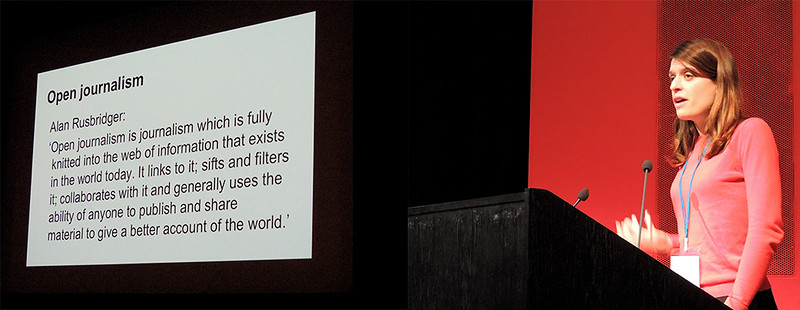 |
| Hannah Freeman, Guardian Community coordinator for culture at UKMW13. Photo: Andrew Lewis |
 |
| Michael John Gorman, The Ablative Museum |
Possible principles for 'the open museum'?
While the theme of the day was the power of participation, I've found myself reflecting more on the organisational challenges this creates. Below are the Guardian's 10 principles of open journalism. As many of the presentations at UKMW13 proved, museums are already doing some of these, but which others could be adapted to help museums deal with the challenges they face now and in the future?
- It encourages participation. It invites and/or allows a response
- It is not an inert, "us" or "them", form of publishing
- It encourages others to initiate debate, publish material or make suggestions. We can follow, as well as lead. We can involve others in the pre-publication processes
- It helps form communities of joint interest around subjects, issues or individuals
- It is open to the web and is part of it. It links to, and collaborates with, other material (including services) on the web
- It aggregates and/or curates the work of others
- It recognizes that journalists are not the only voices of authority, expertise and interest
- It aspires to achieve, and reflect, diversity as well as promoting shared values
- It recognizes that publishing can be the beginning of the journalistic process rather than the end
- It is transparent and open to challenge – including correction, clarification and addition
A related question that arose from Hannah's talk - are museums now in the media business, like it or not? And if our audiences expect museums to be media providers, how do we manage those expectations? (For an alternative model, read David Weinberger's Library as Platform.)
Emerging themes from UKMW13
I've already posted my opening notes for Museums on the Web 2013: 'Power to the people' but I want to go back to two questions I was poking around there: 'how can technologists share our knowledge and experience with others?', and 'why isn't the innovation we know happens in museum technology reflected in reports like last week's 'Digital Culture: How arts and cultural organisations in England use technology'? (Or, indeed, in the genre of patronising articles and blog posts hectoring museums for not using technology.) This seems more relevant than I thought it would be in 2013. Last year I was wondering how to define the membership of the Museums Computer Group when everyone in museums was a bit computer-y, but maybe broad digital literacy and comfort with technology-lead changes in museum practice is further off than I thought. (See also Rachel Coldicutt's 'I Say “Digital!”, You Say “Culture!”'). How do we bridge the gap? Is it just a matter of helping every museum go through the conversations necessary to create a digital strategy and come out the other side? And whose job is it to help museum staff learn how to manage public engagement, ecommerce, procurement, hiring when the digital world changes so quickly?
Another big theme was a reminder of how much is possible when you have technical expertise on hand to translate all the brilliant ideas museums have into prototypes or full products. At one point I jokingly tweeted that the museum and heritage sector would make huge leaps if we could just clone Jim O'Donnell (or the BBC's R&D staff). Perhaps part of the 'museums are digitally innovative'/'museums suck at digital' paradox is that technologists can see the potential of projects and assume that a new standard has been set, but it takes a lot more time and work to get them integrated into mainstream museum practice. Part of this may be because museums struggle to hire and keep really good developers, and don't give their developers the time or headspace to play and innovate. (Probably one reason I like hackdays - it's rare to get time to try new things when there is more worthy work than there is developer/technologist time - being inspired at conferences only goes so far when you can't find a bit of server space and a free day to try something out.) This has also been a theme at the first day at MCN2013, from what I've seen on twitter/webcasts from afar, so it's not only about the budget cuts in the UK. The Digital Culture report suggests that it may also be because senior management in museums don't know how to value 'digital experimentation'?
Other, more positive, themes emerged to link various presentations during the day. Community engagement can be hugely rewarding, but it takes resources - mostly staff time - to provide a conduit between the public and the organisation. It also takes a new mindset for content creators, whether journalists, educators or curators to follow the crowds' lead, but it can be rewarding, whether it's getting help identifying images from 'armchair archaeologists', working with online music communities to save their memories before they're lost to living memory or representing residents experiences of their city. Both presenters and the audience were quick to raise questions about the ethics of participatory projects and the wider implications of content/item collecting projects and citizen history.
Open content enables good things to happen. Digital platforms are great at connecting people, but in-person meetups and conversations are still special.
Finally, one way or another the audience will shape your projects to their own ends, and the audience proved it that day by taking to twitter to continue playing Curate-a-Fact between tea breaks.
We should have a proper archive of all the #UKMW13 tweets at some point, but in the meantime, here's a quick storify for MCG's Museums on the Web 2013: Power to the people. Oh, and thank you, thank you, thank you to all the wonderful people who helped the day come together.
Saturday, 16 November 2013
Opening notes for Museums on the Web 2013: 'Power to the people'
It'll take me a few days to digest the wonderfulness that was MCG's UK Museums on the Web 2013: 'Power to the people', so in lieu of a summary, here are my opening notes for the conference... (With the caveat that I didn't read this but still hopefully hit most of these points on the day).
Welcome to Museums on the Web 2013! I'm Mia Ridge, Chair of the Museums Computer Group.
Hopefully the game that began at registration has helped introduce you to some people you hadn't met before...You can vote on the game in the auditorium over the lunch break, and the winning team will be announced before the afternoon tea break. Part of being a welcoming community is welcoming others, so we tried to make it easier to start conversations. If you see someone who maybe doesn't know other people at the event, say hi. I know that many of you can feel like you're working alone, even within a big organisation, so use this time to connect with your peers.
This week saw the launch of a report written for Nesta, the Arts Council, and the Arts and Humanities Research Council in relation to the Digital R&D Fund for the Arts, 'Digital Culture: How arts and cultural organisations in England use technology'. One line in the report stood out: 'Museums are less likely than the rest of the sector to report positive impacts from digital technologies' - which seems counter-intuitive given what I know of museums making their websites and social media work for them, and the many exciting and effective projects we've heard about over the past twelve years of MCG's UK Museums on the Web conferences (and on our active discussion list).
The key to that paradox may lie in another statement in the report: museums report 'lower than average levels of digital expertise and empowerment from their senior management and a lower than average focus on digital experimentation, and research and development'.* (It may also be that a lot of museum work doesn't fit into an arts model, but that's a conversation for another day.) Today's theme almost anticipates this - our call for papers around 'Power to the people' asked for responses around the rise of director-level digital posts the rise of director-level digital posts and empowering museum staff to learn through play as well as papers on grassroots projects and the power of embedding digital audience participation and engagement into the overall public engagement strategy for a museum.
Today we'll be hearing about great projects from museums and a range of other organisations, but reports like this - and perhaps the wider issue of whether senior management and funders understand the potential of digital beyond new forms of broadcast and ticket sales - raises the question of whether we're preaching to the converted. How can we help others in museums benefit from the hard-won wisdom and lessons you'll hear today?
The Museums Computer Group has always been a platform for people working with museum technology who want to create positive change in the sector: our motto is 'connect, support, inspire', and we're always keen to hear your ideas about how we can help you connect, support and inspire you, but as a group we should also be asking: how can we share our knowledge and experience with others? It can be difficult to connect with and support others when you're flat out with your own work, yet the need to scale up the kinds of education we might have done with small groups working on digital projects is becoming more urgent as audience expectations change and resources need to be spent even more carefully. Ultimately we can help each other by helping the sector get better at technology and recognise the different types of expertise already available within the heritage sector. Groups like the MCG can help bridge the gap; we need your voices to reach senior management as well as practitioners and those who want to work with museums who'll shape the sector in the future.
It's rare to find a group so willing to share their failures alongside their successes, so willing to generously share their expertise and so keen to find lessons in other sectors. We appreciate the contributions of many of you who've spoken honestly about the successes and failures of your projects in the past, and applaud the spirit of constructive conversation that encourages your peers to share so openly and honestly with us. I'm looking forward to learning from you all today.
* Update to add a link to an interview with MTM's Richard Ellis who co-authored the Nesta report, who says the 'sheer extent of the divide between those in the know and those not' was one of the biggest surprises working in the culture sector.
Welcome to Museums on the Web 2013! I'm Mia Ridge, Chair of the Museums Computer Group.
Hopefully the game that began at registration has helped introduce you to some people you hadn't met before...You can vote on the game in the auditorium over the lunch break, and the winning team will be announced before the afternoon tea break. Part of being a welcoming community is welcoming others, so we tried to make it easier to start conversations. If you see someone who maybe doesn't know other people at the event, say hi. I know that many of you can feel like you're working alone, even within a big organisation, so use this time to connect with your peers.
This week saw the launch of a report written for Nesta, the Arts Council, and the Arts and Humanities Research Council in relation to the Digital R&D Fund for the Arts, 'Digital Culture: How arts and cultural organisations in England use technology'. One line in the report stood out: 'Museums are less likely than the rest of the sector to report positive impacts from digital technologies' - which seems counter-intuitive given what I know of museums making their websites and social media work for them, and the many exciting and effective projects we've heard about over the past twelve years of MCG's UK Museums on the Web conferences (and on our active discussion list).
The key to that paradox may lie in another statement in the report: museums report 'lower than average levels of digital expertise and empowerment from their senior management and a lower than average focus on digital experimentation, and research and development'.* (It may also be that a lot of museum work doesn't fit into an arts model, but that's a conversation for another day.) Today's theme almost anticipates this - our call for papers around 'Power to the people' asked for responses around the rise of director-level digital posts the rise of director-level digital posts and empowering museum staff to learn through play as well as papers on grassroots projects and the power of embedding digital audience participation and engagement into the overall public engagement strategy for a museum.
Today we'll be hearing about great projects from museums and a range of other organisations, but reports like this - and perhaps the wider issue of whether senior management and funders understand the potential of digital beyond new forms of broadcast and ticket sales - raises the question of whether we're preaching to the converted. How can we help others in museums benefit from the hard-won wisdom and lessons you'll hear today?
The Museums Computer Group has always been a platform for people working with museum technology who want to create positive change in the sector: our motto is 'connect, support, inspire', and we're always keen to hear your ideas about how we can help you connect, support and inspire you, but as a group we should also be asking: how can we share our knowledge and experience with others? It can be difficult to connect with and support others when you're flat out with your own work, yet the need to scale up the kinds of education we might have done with small groups working on digital projects is becoming more urgent as audience expectations change and resources need to be spent even more carefully. Ultimately we can help each other by helping the sector get better at technology and recognise the different types of expertise already available within the heritage sector. Groups like the MCG can help bridge the gap; we need your voices to reach senior management as well as practitioners and those who want to work with museums who'll shape the sector in the future.
It's rare to find a group so willing to share their failures alongside their successes, so willing to generously share their expertise and so keen to find lessons in other sectors. We appreciate the contributions of many of you who've spoken honestly about the successes and failures of your projects in the past, and applaud the spirit of constructive conversation that encourages your peers to share so openly and honestly with us. I'm looking forward to learning from you all today.
* Update to add a link to an interview with MTM's Richard Ellis who co-authored the Nesta report, who says the 'sheer extent of the divide between those in the know and those not' was one of the biggest surprises working in the culture sector.
Friday, 7 June 2013
'Engaging Visitors Through Play' - the Museums Computer Group in Belfast
Last week I was in Belfast for the Museum Computer Group's Spring event, 'Engaging Visitors Through Play', fabulously organised by Alan Hook (Lecturer, University of Ulster) and Oonagh Murphy (MCG Committee member and PhD Researcher, University of Ulster) with support from the MCG Committee, and hosted by the University of Ulster's Centre for Media Research.

Like other recent MCG event reports, I'm also writing as the Chair of the group, so you may think I'm biased when I say it was an excellent day with great speakers, but if I am at all biased, I promise it's only a tiny bit! I've posted my talk notes at 'Digital challenges, digital opportunities' at MCGPlay, Belfast.
The MCG's Spring Meeting is an opportunity to take a wider theme than our annual Museums on the Web conference (which as the name suggests, is generally about things that touch on museums on the web). This year's topic was 'Engaging Visitors Through Play', with presentations on playful experiences from site-specific theatre, rapid prototyping and hack days, big budget and experimental games. The event was an opportunity to bring museum staff and researchers together with game and interaction designers, and the 'regional showcase' of lightning talks about projects from local practitioners further helped introduce people to the great work already going on in Northern Ireland and hopefully start some local collaborations. As Alan pointed out in his introduction, it was also a chance to think about the impact of research and start conversations between museums and academia.
The first session after my talk was 'Play: A Northern Ireland Showcase' and began with Lyndsey Jackson (@LyndseyJJackson) of Kabosh talking about 'Immersive Theatre and Digital Experience' and their site-specific theatre company. Their material is the buildings, people and stories of Northern Ireland and they work with unusual spaces - anywhere but a theatre. They're dealing with two interesting constraints – the stories of buildings might be complicated, contested or difficult, and while they want to give audiences the chance to navigate an experience for themselves, they're aware that 'theatre is a game - it has rules, boundaries, you can bend them but it confuses people when you break them'. In a lovely departure from some museum experiences, they don't try to give their audiences all the answers – sometimes they want to give people some information in a way that starts them asking questions so they have to look things up themselves if they want to know more. I wish I'd had longer in Belfast to see one of their shows or try 'Belfast Bred'.
Oonagh (@oonaghtweets) presented some results from her audit of the online presences of museums in Northern Ireland and the question she set out to test: that professional development hack days can help the sector. Find out more at her MW2013 paper on 'This is Our Playground'; but one fascinating snippet was that museum studies students are quite conservative, 'museums have rules for a reason', and take a while to warm to the concept of prototyping. Alan (@alan_hook) talked about MYNI photo competition, asking 'is Northern Ireland ready for play in these spaces?', games that work with 'civic pride', the realities of designing mobile experiences around 3G coverage and expensive data plans, and shared some reflections on the process, including his questions about the ethics of crowdsourcing images and the differences between academic and industry timelines.
The next session was 'Games: Best Practice and Innovative Approaches'. First up, Sharna Jackson (@sharnajackson), czar of Tate Kids, presented on the past, present and future of play at Tate. She pointed out that games can bring in hard-to-reach audiences, can be a gateway to engagement with deeper content, and can be a work of art in themselves. I loved her stance on web vs device-specific apps – while tablets are increasingly popular, their aim is to reach wide audiences so jumping into apps might not be right choice for limited budgets. Her lessons included: know your audience, what they expect; start playing games so you know what mechanics you like so you've got context for decisions and so you get what's great about games; your mission, content and goals all influence what kinds of games it makes sense for you to make; if planning to let users generate content, you need a strategy to manage it. Be clear about what games are - respect the medium.
Danny Birchall (@dannybirchall) of the Wellcome Collection talked about 'Truth and Fact: Museums and Public Engagement, including the High Tea evaluation's findings that 'piracy is the most effective form of distribution' so designing games to be ripped or seeded on portals can help achieve wider goals. He also talked about the differences between history and science games, as well as some of the unique hazards of working in museums with large, closely related collections - one memory game was 'punishing you with intense sense of similarity of items in Henry Wellcome's collection'.
The final presentation in the session was Alex Moseley on the educational potential of low budget games. His talk included a tiny taster of alternative reality gameplay and discussion of some disruptive, slightly subversive elements of ARGs you could use independently. His seven step process: identify key concepts or constraints want to get across; situate them in real activities; think of a real problem or challenge; add narrative to deepen the context; create a prototype; test it with colleagues/visitors; refine, retest and release. He also raised some challenges for museums: if players suggest something good in an ARG, it could be incorporated and effect the outcome - but this might be tricky for museums to manage with limited resources.
One interesting test that emerged from the panel discussion was whether something was 'Belfast good'. As Oonagh said, 'Is this good or is it 'Belfast-good' because if it's Belfast-good, then not good enough'. Asking whether a project is 'museum good' or 'academic good' might be a useful test in the future... The session also lead to 'chocolate covered broccoli' references overtaking 'gamification' as the new buzzword bingo winner.
The lightning talks covered a range of interesting projects from local organisations, in part with the idea of helping start local conversations. Some of the projects we heard about from @takebackbelfast, @stephentshaw, @designzoo and @Lancorz were really inspiring and just plain cool. It was also refreshing to hear outsider's perspectives on what museums do: one guy said 'people bring their own knowledge, experiences and devices to museums - why do you need big interactive installations?'.
 The day finished with a twenty minute play test of Alex Moseley's 'curate-a-fact' game then we headed off to the pub for some well-deserved #drinkingaboutmuseums.
The MCG usually holds its Spring Meeting somewhere outside London, but it's a long time since we've been in Belfast - it might have been a long time coming, but Belfast did themselves proud. I was really encouraged by the excellent work going on in the region and the creativity and energy of the people and projects in the room. Huge thanks to all the participants, chairs, speakers and organisers for putting together a great day!
Thanks to the university, we were able to (mostly) live stream the talks, and had people watching at their desk in Leicester or London and even from a train in New York! We also had a live tweeter @JasonAPurdy on the @cmr_ulster account plus loads of tweeters in the audience to help capture the day. Alex has also posted his thoughts on 'Engaging Visitors Through Play' - well worth a read.
Like other recent MCG event reports, I'm also writing as the Chair of the group, so you may think I'm biased when I say it was an excellent day with great speakers, but if I am at all biased, I promise it's only a tiny bit! I've posted my talk notes at 'Digital challenges, digital opportunities' at MCGPlay, Belfast.
The MCG's Spring Meeting is an opportunity to take a wider theme than our annual Museums on the Web conference (which as the name suggests, is generally about things that touch on museums on the web). This year's topic was 'Engaging Visitors Through Play', with presentations on playful experiences from site-specific theatre, rapid prototyping and hack days, big budget and experimental games. The event was an opportunity to bring museum staff and researchers together with game and interaction designers, and the 'regional showcase' of lightning talks about projects from local practitioners further helped introduce people to the great work already going on in Northern Ireland and hopefully start some local collaborations. As Alan pointed out in his introduction, it was also a chance to think about the impact of research and start conversations between museums and academia.
The first session after my talk was 'Play: A Northern Ireland Showcase' and began with Lyndsey Jackson (@LyndseyJJackson) of Kabosh talking about 'Immersive Theatre and Digital Experience' and their site-specific theatre company. Their material is the buildings, people and stories of Northern Ireland and they work with unusual spaces - anywhere but a theatre. They're dealing with two interesting constraints – the stories of buildings might be complicated, contested or difficult, and while they want to give audiences the chance to navigate an experience for themselves, they're aware that 'theatre is a game - it has rules, boundaries, you can bend them but it confuses people when you break them'. In a lovely departure from some museum experiences, they don't try to give their audiences all the answers – sometimes they want to give people some information in a way that starts them asking questions so they have to look things up themselves if they want to know more. I wish I'd had longer in Belfast to see one of their shows or try 'Belfast Bred'.
Oonagh (@oonaghtweets) presented some results from her audit of the online presences of museums in Northern Ireland and the question she set out to test: that professional development hack days can help the sector. Find out more at her MW2013 paper on 'This is Our Playground'; but one fascinating snippet was that museum studies students are quite conservative, 'museums have rules for a reason', and take a while to warm to the concept of prototyping. Alan (@alan_hook) talked about MYNI photo competition, asking 'is Northern Ireland ready for play in these spaces?', games that work with 'civic pride', the realities of designing mobile experiences around 3G coverage and expensive data plans, and shared some reflections on the process, including his questions about the ethics of crowdsourcing images and the differences between academic and industry timelines.
The next session was 'Games: Best Practice and Innovative Approaches'. First up, Sharna Jackson (@sharnajackson), czar of Tate Kids, presented on the past, present and future of play at Tate. She pointed out that games can bring in hard-to-reach audiences, can be a gateway to engagement with deeper content, and can be a work of art in themselves. I loved her stance on web vs device-specific apps – while tablets are increasingly popular, their aim is to reach wide audiences so jumping into apps might not be right choice for limited budgets. Her lessons included: know your audience, what they expect; start playing games so you know what mechanics you like so you've got context for decisions and so you get what's great about games; your mission, content and goals all influence what kinds of games it makes sense for you to make; if planning to let users generate content, you need a strategy to manage it. Be clear about what games are - respect the medium.
Danny Birchall (@dannybirchall) of the Wellcome Collection talked about 'Truth and Fact: Museums and Public Engagement, including the High Tea evaluation's findings that 'piracy is the most effective form of distribution' so designing games to be ripped or seeded on portals can help achieve wider goals. He also talked about the differences between history and science games, as well as some of the unique hazards of working in museums with large, closely related collections - one memory game was 'punishing you with intense sense of similarity of items in Henry Wellcome's collection'.
The final presentation in the session was Alex Moseley on the educational potential of low budget games. His talk included a tiny taster of alternative reality gameplay and discussion of some disruptive, slightly subversive elements of ARGs you could use independently. His seven step process: identify key concepts or constraints want to get across; situate them in real activities; think of a real problem or challenge; add narrative to deepen the context; create a prototype; test it with colleagues/visitors; refine, retest and release. He also raised some challenges for museums: if players suggest something good in an ARG, it could be incorporated and effect the outcome - but this might be tricky for museums to manage with limited resources.
One interesting test that emerged from the panel discussion was whether something was 'Belfast good'. As Oonagh said, 'Is this good or is it 'Belfast-good' because if it's Belfast-good, then not good enough'. Asking whether a project is 'museum good' or 'academic good' might be a useful test in the future... The session also lead to 'chocolate covered broccoli' references overtaking 'gamification' as the new buzzword bingo winner.
The lightning talks covered a range of interesting projects from local organisations, in part with the idea of helping start local conversations. Some of the projects we heard about from @takebackbelfast, @stephentshaw, @designzoo and @Lancorz were really inspiring and just plain cool. It was also refreshing to hear outsider's perspectives on what museums do: one guy said 'people bring their own knowledge, experiences and devices to museums - why do you need big interactive installations?'.
The day finished with a twenty minute play test of Alex Moseley's 'curate-a-fact' game then we headed off to the pub for some well-deserved #drinkingaboutmuseums.The MCG usually holds its Spring Meeting somewhere outside London, but it's a long time since we've been in Belfast - it might have been a long time coming, but Belfast did themselves proud. I was really encouraged by the excellent work going on in the region and the creativity and energy of the people and projects in the room. Huge thanks to all the participants, chairs, speakers and organisers for putting together a great day!
Thanks to the university, we were able to (mostly) live stream the talks, and had people watching at their desk in Leicester or London and even from a train in New York! We also had a live tweeter @JasonAPurdy on the @cmr_ulster account plus loads of tweeters in the audience to help capture the day. Alex has also posted his thoughts on 'Engaging Visitors Through Play' - well worth a read.
'Digital challenges, digital opportunities' at MCGPlay, Belfast
These are my rough notes for my talk on 'Digital challenges, digital opportunities' at Museum Computer Group's Spring event, 'Engaging Visitors Through Play' (or #MCGPlay). My aim was to introduce the Museums Computer Group, discuss some of the challenges museums and their staff are facing and think about how to create opportunities from those challenges. I've posted my notes about the other talks at MCGPlay at 'Engaging Visitors Through Play' - the Museums Computer Group in Belfast.
I started with some information about the MCG - our mission to connect, support and inspire people working with museum technology (whether technologists, curators, academics, directors or documentation staff) and how that informs the events we run and platforms like our old-school but effective mailing list, whose members who can between them answer almost any museumy question you can think of. As a practioner-led group of volunteers, the MCG can best fulfill its mission by acting as a platform, and with over 1000 members on our mailing list and hundreds of attendees at events, we can help people in the sector help and inspire each other in a mutually supportive space. We've also been involved in projects like the Semantic Web Think Tank (2006-2007), Mashed Museum hack days (2007, 2008) and LIVE!Museum (2009-2010). Apparently list discussions even inspired Culture24's Let's Get Real analytics project! In response to surveys with our members we're experimenting with more regional events, and with event formats like the 'Failure Swapshop' we trialled early this week and #drinkingaboutmuseums after the conference. (On a personal note, reviewing our history and past events was a lovely excuse to reflect on the projects and events the MCG community has been involved in and also to marvel at how young familiar faces looked at past events).
I'd reviewed the MCG list subject lines over the past few months to get a sense of the chalenges or questions that digital museum people were facing:
I finished by saying that despite all the frustrations, it's an amazing time to work in or study the sector, so enjoy it! We shouldn't limit ourselves to engaging audiences in play when we could be engaging ourselves in play.

 |
| Play testing Alex's game at #MCGPlay |
I'd reviewed the MCG list subject lines over the past few months to get a sense of the chalenges or questions that digital museum people were facing:
- Finding good web design/SEO/evaluation/etc agencies, finding good staff
- The emergence of 'head of digital' roles
- Online collections, managing digital assets; integration with Collections Management Systems and other systems
- Integrating Collections Management Systems and 3rd party platforms like WordPress
- Storytelling to engage the public
- Museum informatics: CIDOC-CRM and other linked open data topics
- 'Create once, publish everywhere' – can re-usable content really work?
- Online analytics
- Digital 3D objects – scanning, printing
- Measuring the impact of social media
- MOOCs (online courses)
- Google Cultural Institute, Google Art Project, Artsy, etc
- 3rd party tools - PayPal, Google Apps
- Mobile - apps, well-designed experiences
- Digital collections in physical exhibitions spaces
- Touch tables/large-scale interactives
- The user experience of user-generated content / co-produced exhibitions
- 'Strategically digital' - the topic of many conversations over the past few years, including MCG's Museums on the Web 2012, which was actually partly about saying that best solution for a project might not involve technology. Being 'strategically digital' offers some solutions to the organisational change issues raised by the mismatch between web speed and museum speed, and it means technology decisions should always refer back to a museum's public engagement strategy (or infrastructure plans for background ICT services).
- Mobile - your museum's website probably has over 20% mobile visitors, so if you're not thinking about the quality of their experience, you may be driving away business.
- Immersive, challenging experiences - the influence of site-specific theatre, alternative reality games and transmedia experiences, the ever-new value of storytelling...
- High-quality services integrated across the whole museum - new terms like service design and design thinking, are taking over from the old refrain of user-centred design, and going beyond it to test how the whole organisation appears to the customer – does it feel like a seamless, pleasurable (or at least not painful) experience? Museums are exploring new(ish) ways of thinking to solve old problems. As with mobile sites, you should be designing around your audiences needs, not your internal structures and complications.
- Audience participation and engagement - we'll hear about games over the day, but also think about crowdsourcing, asking the audience to help with tasks or share their knowledge with you.
- New models of authority and expertise - museum authority is challenged not only by audiences expecting to 'curate' their own experience but also by younger staff or people who've come from other sectors and have their own ideas about digital projects.
- Constantly changing audience expectations - if you've ever seen kids smoosh their hands on a screen because they expect it to zoom in response to their touch, you'll know how hard it is to keep up with consumer technologies. Expectations about the quality of the experience and the quality of the technology are always changing based on films, consumer products and non-museum experiences.
- 'Doing more with less' (and then less again)
- Figuring out where to ask for help - it can be hard to find your way through the jargon and figure out what language to use
- Training and personal development - job swaps or mentoring might supplement traditional training
I finished by saying that despite all the frustrations, it's an amazing time to work in or study the sector, so enjoy it! We shouldn't limit ourselves to engaging audiences in play when we could be engaging ourselves in play.

Monday, 29 October 2012
'Behind-the-themes' at the UK Museums on the Web conference - UKMW12 'Strategically Digital'
Full disclosure: I'm the Chair of the Museums Computer Group, and in this case I also chaired the Programme Committee, but I think we've put together a really strong programme. I thought I'd provide some background here about where the themes came from. (Also, I'll take any excuse for a punning title.)
When putting together the themes, I reviewed reports from a number of international conferences and went through the archives of the MCG's mailing list to get a sense of the issues that were both bugging our members on a daily basis and having an impact on museums more generally. I've also spent time talking to staff in museums in Australia, New Zealand, Taiwan, the US and (of course) the UK and those conversations also informed the themes. I also referred back to the MCG Committee's discussions about our vision for 'MCG@30', which included supporting our members by advocating for their work at higher levels of the museum sector. Hopefully this event is part of this process, as is a session on 'digital strategy' at the Museums Association conference.
For me, being 'strategically digital' means the best solution for a project might not involve technology. Being 'strategically digital' offers some solutions to the organisational change issues raised by the mismatch between web speed and museum speed, and it means technology decisions should always refer back to a museum's public engagement strategy (or infrastructure plans for background ICT services).
Like our 'Engaging digital audiences in museums' Spring meeting that aimed to get museum technologists and educators talking and learning from each other, UKMW12 is about breaking out of our comfortable technology-focused bubble and making sure the goals and language of web and digital teams relate to the rest of the organisation; it's also about helping the rest of the museum understand your work. We've seen a range of people sign up for tickets so far, so hopefully the day will provide a chance for staff to understand more about the workings of their own museum as well as the museums presenting on the day. The conference is grounded in reality: our speakers address both successes and failures in digital strategies and organisational change. You can get a sneak preview of the range of discussion on the day at Andrew Dobson's post on '10 things I have learned working for Sky', Tate's Online Strategy or Caper on Happenstance, Simon Tanner's 'Balanced Value Impact Model' and of course through the talk abstracts in the programme. Some of our best Museums on the Web conferences have featured a similar mix of fresh voices from outside the sector and hard-won wisdom from within the sector, so I have high hopes for this event.
After some thought, a call for papers and the input of the wonderful 2012 Programme Committee (Ross Parry, Melissa Terras, Carolyn Royston and Stuart Dunn), this is the result:

On a personal note, this event will mark 30 years since the first ever Museums Computer Group event, and eight years since the first UK Museums on the Web conference - a milestone worth celebrating! If you'd like to be an active part of the MCG's future, we'll be electing new committee members in the lunchtime AGM on November 30. Get in touch if you're curious about how you could contribute...
When putting together the themes, I reviewed reports from a number of international conferences and went through the archives of the MCG's mailing list to get a sense of the issues that were both bugging our members on a daily basis and having an impact on museums more generally. I've also spent time talking to staff in museums in Australia, New Zealand, Taiwan, the US and (of course) the UK and those conversations also informed the themes. I also referred back to the MCG Committee's discussions about our vision for 'MCG@30', which included supporting our members by advocating for their work at higher levels of the museum sector. Hopefully this event is part of this process, as is a session on 'digital strategy' at the Museums Association conference.
For me, being 'strategically digital' means the best solution for a project might not involve technology. Being 'strategically digital' offers some solutions to the organisational change issues raised by the mismatch between web speed and museum speed, and it means technology decisions should always refer back to a museum's public engagement strategy (or infrastructure plans for background ICT services).
Like our 'Engaging digital audiences in museums' Spring meeting that aimed to get museum technologists and educators talking and learning from each other, UKMW12 is about breaking out of our comfortable technology-focused bubble and making sure the goals and language of web and digital teams relate to the rest of the organisation; it's also about helping the rest of the museum understand your work. We've seen a range of people sign up for tickets so far, so hopefully the day will provide a chance for staff to understand more about the workings of their own museum as well as the museums presenting on the day. The conference is grounded in reality: our speakers address both successes and failures in digital strategies and organisational change. You can get a sneak preview of the range of discussion on the day at Andrew Dobson's post on '10 things I have learned working for Sky', Tate's Online Strategy or Caper on Happenstance, Simon Tanner's 'Balanced Value Impact Model' and of course through the talk abstracts in the programme. Some of our best Museums on the Web conferences have featured a similar mix of fresh voices from outside the sector and hard-won wisdom from within the sector, so I have high hopes for this event.
After some thought, a call for papers and the input of the wonderful 2012 Programme Committee (Ross Parry, Melissa Terras, Carolyn Royston and Stuart Dunn), this is the result:

The Museums Computer Group's annual Museums on the Web conference – UKMW12 – will be held at the Wellcome Collection in London on 30 November 2012.
UKMW12 is about being ‘strategically digital’. Responding to the issues faced by museums today, it's an opportunity to take a step back from the everyday and think strategically about the impact of the digital revolution on your museum and on the sector as a whole, including themes such as: digitally enabling the modern museum and its staff; sustaining the digital agenda and the realities of digital strategies and organisational change; and the complexities of digital engagement and the impact of social media on audience expectations.
UKMW12 brings together speakers from organisations including the Tate, the V&A, UCL, King's College, the Guardian, Strategic Content Alliance, Collections Trust and Caper.
As always, UK Museums on the Web is a day for being inspired by the latest ideas, for learning from case studies grounded in organisations like yours, and for networking with other technologists, curators, managers, academics, learning and marketing specialists in the museum and heritage sector.
Don't miss out! Book your ticket now at http://ukmw12.eventbrite.co.ukIf you've never been (or haven't been for a while) to an MCG event, these posts link to several event reports from attendees and should give you an idea of who goes and what's discussed: Your blog posts and tweets about ‘Engaging digital audiences in museums’ (Spring 2012); UKMW11 Blog Posts (theme: The innovative museum: creating a brighter future); UK Museums on the Web 2010.
Find out more about the conference at http://bit.ly/ukmw12.
On a personal note, this event will mark 30 years since the first ever Museums Computer Group event, and eight years since the first UK Museums on the Web conference - a milestone worth celebrating! If you'd like to be an active part of the MCG's future, we'll be electing new committee members in the lunchtime AGM on November 30. Get in touch if you're curious about how you could contribute...
Friday, 13 July 2012
'Engaging digital audiences in museums' conference
A quick report and Storify summary from Wednesday's joint Museums Computer Group (MCG) and Digital Learning Network (DLNet) conference, 'Engaging digital audiences in museums', which was held on 11 July 2012 at the University of Manchester. I'm the Chair of the MCG and was on the Programming Committee for this event so I make absolutely no claim to impartiality, but I thought it went really well - great speakers and workshop leaders, enthusiastic and friendly participants and a variety of formats that kept energy levels up during the day.
My notes are sketchier than usual as I was co-chairing some of the sessions and keeping an eye on the running of the event, so this is more of an impressionistic overview than a detailed report. There are already a number of other posts out there, and we'll have the post from our official event blogger and illustrator up soon for more comprehensive accounts.
For the MCG, this event was experimental in a number of ways - in running an event with another practitioner organisation, in the venue, in running parallel workshops, buying in commercial wifi, and in devoting part of the day to an unconference - and I'm curious to know what response we get in the evaluation from the day. (If you were there, our short feedback form is online.)
The event was designed to bring museum learning and technology staff together because we felt we were missing opportunities to benefit from each others skills and experience. I know technologists are grappling with measuring impact, and learning people with reaching new audiences in different ways - hopefully each group would have something to offer and something to learn, though it might mean seeing past each others jargon and understanding different views of the world. (This 'Interloper Report' and comments from MW2012 provide some insight into the potential.) We planned the day as a mixture of inspiring talks and opportunities to get stuck into conversation about topical issues. It was also a day for making connections so we'd included coffee breaks, lunch and the unconference so that people could find others interested in similar things or to put faces to names from the MCG and DLNet lists and social media.
The various tweets I've added to storify do a reasonable job of covering the day, but I've left out things like the QR code discussion. Other conversations about generic learning outcomes have taken on a life of their own - for example, Rhiannon's post 'Generic Learning Outcomes - friend or foe?' seeks to understand why non-learning people don't seem to like them.
I thought Nick Winterbotham's presentation of the Group for Education in Museums (GEM) 'self-evident truths' was interesting, and some of his points were picked up and retweeted widely:
Nick advocated for a world where no-one hesitates at taking a risk in learning, and said that we love art, digital culture because of how we feel about it, not what we know about it. He urged us to focus on how your audiences live, learn and love your subject matter; to acknowledge the intellectual generosity needed; and find the big idea that will transform your organisation.
Matthew Cock talked about the challenges of audiences, particularly around mobile. The three-pronged model for audiences in museums: attract -> engage -> impact. He asked, when you see someone in a museum with a phone, what space are they in? Are they engaged, distracted, focused? Is it a sign of disrespect and disengagement or a sign of bonding with the group they're with? And how do you know?
People are seeking venues and events that engage them in a memorable (and authentic?) ways - we're shifting from buying lots of stuff to seeking unique and engaging experiences. The visitor wants to walk away with the engagement having effected a transformation (the impact point of the three-pronged model). Measuring that impact is really hard. Evaluation can look at lots of things but it's hard to understand the needs of our visitors and what works for them in this space.
Later I asked what Learning people like Nick could tell us technologists about measuring impact, but it seems like it's the holy grail for their field too. Nick did mention that we go from a stage of cognitive to affective impact over time after an experience, which is a good start for thinking about this. Judging from the response on twitter, I'm not the only one who thinks that measuring the impact of a museum experience and understanding whether it's ephemeral or lifelong is one of the big tasks for museums right now.
John Coburn's presentation on the Hidden Newcastle app harked back to the buzz around storytelling
a few years ago, but it also resonated with conversations about the different types and purposes of museum websites - an app that's not about sharing collections or objects but about sharing compelling stories fits firmly in the 'messy middle'. In this case, 'it's the story that creates the impact, not the object. The value of the object is as the source for the story'. I love that they wanted to create intrigue about the people and the times in which they lived and compel exploration.
It was a difficult choice but I popped into the 'tech on a budget' workshop where Shona Carnall and Greg Povey presented some interesting ways to use existing, readily available technologies to create interactive experiences.
We're already looking ahead to the MCG's Spring 2013 meeting, which may be an experimental 'distributed' meeting held in the same week or evening in different regional locations. If you're interested in hosting a small-scale event with us somewhere in the UK, get in touch! We're also thinking about themes for UK Museums on the Web 2012, so again, let us know if you have any ideas.
My notes are sketchier than usual as I was co-chairing some of the sessions and keeping an eye on the running of the event, so this is more of an impressionistic overview than a detailed report. There are already a number of other posts out there, and we'll have the post from our official event blogger and illustrator up soon for more comprehensive accounts.
For the MCG, this event was experimental in a number of ways - in running an event with another practitioner organisation, in the venue, in running parallel workshops, buying in commercial wifi, and in devoting part of the day to an unconference - and I'm curious to know what response we get in the evaluation from the day. (If you were there, our short feedback form is online.)
The event was designed to bring museum learning and technology staff together because we felt we were missing opportunities to benefit from each others skills and experience. I know technologists are grappling with measuring impact, and learning people with reaching new audiences in different ways - hopefully each group would have something to offer and something to learn, though it might mean seeing past each others jargon and understanding different views of the world. (This 'Interloper Report' and comments from MW2012 provide some insight into the potential.) We planned the day as a mixture of inspiring talks and opportunities to get stuck into conversation about topical issues. It was also a day for making connections so we'd included coffee breaks, lunch and the unconference so that people could find others interested in similar things or to put faces to names from the MCG and DLNet lists and social media.
The various tweets I've added to storify do a reasonable job of covering the day, but I've left out things like the QR code discussion. Other conversations about generic learning outcomes have taken on a life of their own - for example, Rhiannon's post 'Generic Learning Outcomes - friend or foe?' seeks to understand why non-learning people don't seem to like them.
I thought Nick Winterbotham's presentation of the Group for Education in Museums (GEM) 'self-evident truths' was interesting, and some of his points were picked up and retweeted widely:
- Our heritage is not about things it is about people
- Everyone has a right to know about and be at ease with heritage
- Heritage embraces the past and present of all cultures
- Heritage is essential as the cradle of everyone's tomorrow
- Heritage encompasses all literature, science, technology, environments and arts
- The multiple narratives of heritage deserve respect
- Learning is an entitled journey, not a destination
- Heritage learning is an entitlement for everyone
- The development of heritage learning skills must be a perpetual excellence
- Learning is not simply a justification for cultural spending, it is THE justification for cultural spending
Nick advocated for a world where no-one hesitates at taking a risk in learning, and said that we love art, digital culture because of how we feel about it, not what we know about it. He urged us to focus on how your audiences live, learn and love your subject matter; to acknowledge the intellectual generosity needed; and find the big idea that will transform your organisation.
Matthew Cock talked about the challenges of audiences, particularly around mobile. The three-pronged model for audiences in museums: attract -> engage -> impact. He asked, when you see someone in a museum with a phone, what space are they in? Are they engaged, distracted, focused? Is it a sign of disrespect and disengagement or a sign of bonding with the group they're with? And how do you know?
He talked about the work Morris Hargreaves McIntyre had done to understand their audiences and their varying motivations for visiting: social - museums as enjoyable place to spend time with friends and family; intellectual - interested in knowledge; emotional - experience what the past was like; spiritual - creative stimulation, quiet contemplation, etc. (See also MHM's Culture Segments report). How does this connect to using mobiles to engage people? People have different activities - chat, read, recording audio or photo, playing media back, share something via social media etc. Each fulfills a different need. The challenge is to match specific things you can do on a mobile with your motivations for visiting. He referred to Maslow's hierarchy of needs to think about the needs a museum satisfies in our lives and the experience economy.
People are seeking venues and events that engage them in a memorable (and authentic?) ways - we're shifting from buying lots of stuff to seeking unique and engaging experiences. The visitor wants to walk away with the engagement having effected a transformation (the impact point of the three-pronged model). Measuring that impact is really hard. Evaluation can look at lots of things but it's hard to understand the needs of our visitors and what works for them in this space.
Later I asked what Learning people like Nick could tell us technologists about measuring impact, but it seems like it's the holy grail for their field too. Nick did mention that we go from a stage of cognitive to affective impact over time after an experience, which is a good start for thinking about this. Judging from the response on twitter, I'm not the only one who thinks that measuring the impact of a museum experience and understanding whether it's ephemeral or lifelong is one of the big tasks for museums right now.
John Coburn's presentation on the Hidden Newcastle app harked back to the buzz around storytelling
a few years ago, but it also resonated with conversations about the different types and purposes of museum websites - an app that's not about sharing collections or objects but about sharing compelling stories fits firmly in the 'messy middle'. In this case, 'it's the story that creates the impact, not the object. The value of the object is as the source for the story'. I love that they wanted to create intrigue about the people and the times in which they lived and compel exploration.
It was a difficult choice but I popped into the 'tech on a budget' workshop where Shona Carnall and Greg Povey presented some interesting ways to use existing, readily available technologies to create interactive experiences.
I'll leave the detail of the other presentations to the storify below and other people's posts and skip to the unconference. Because time was short we asked for session ideas and votes from the podium, rather than letting people write ideas and put their votes up on a shared board. After the unconference we all gathered again to hear what had been discussed in each group. The summaries were:
- Commercial side of commissioning cool things: reluctant to put a price on it, but UK has cultural expectations around free museums which makes it harder to charge. Digital is received as god given right, something that should be free. But how come the West End theatre is able to charge so much for a ticket? Museums providing paid-for entertainment not just a browsing experience. We pay for entertainment but we don't expect to be entertained in museums.
- Learning outcomes: friends or foe? Attitude is sometimes that learning outcomes are rubbish - decided generic learning outcomes (GLOs) are a really good thing. It's not about shoe-horning facts into everything or pure knowledge transfer - it's also about inspiration, experience, skills, wonderment. The wondrous Romans! Trying to change the stigma about what learning actually is, it's an experience as much as formal education. Maybe 'aims and objectives' a better term than 'learning outcomes'.
- How do you evaluate wonderment - with difficulty. What is it? Element of surprise, something being visceral, physiological responses. Are adults too cynical for wonderment? 'Smiling Victorians' - challenge expectations. Imagine writing a budget to get iris recognition to measure wonder! Hard to measure or evaluate it but should always aspire to it.
- Coherent experience, call to action in gallery to online with mobile in gallery: talked about pressure museums are under to introduce next tech, be whizzy, or is it addressing a real need? Can you piggyback on software that's already out there?
- Reaching different audiences: particularly teenagers: find out what inspires them, tap into that. What are the barriers to engaging them? They're creative, maybe we should work with them to create digital offers, empower them. Apps for apps sake - under pressure to deliver them.
- Big ideas: intellectual generosity. (Goodness! There was a long list of the characteristics MCG and DLNet would have if they were an animal or a tool...) We are intricate explosions. Intricate - all the stuff we're talking about is detailed and a little fragile but explosive because the world will catch fire with what we're doing.
- Failure confessionals: web content management systems - maybe simple is the way to go. Failure is a good thing, and at least we didn't screw up like the bankers.
- Social media audiences: does it make sense just to have one FB, twitter, etc account per org? Keeping a brand together is good but it doesn't always make sense to lump all audience conversations into one channel.
We're already looking ahead to the MCG's Spring 2013 meeting, which may be an experimental 'distributed' meeting held in the same week or evening in different regional locations. If you're interested in hosting a small-scale event with us somewhere in the UK, get in touch! We're also thinking about themes for UK Museums on the Web 2012, so again, let us know if you have any ideas.
Subscribe to:
Posts (Atom)