Here are all the things I (probably) didn't say in my Chair's welcome for the Museums Computer Group annual conference... Other notes, images and tweets from the day are linked from 'UKMW14 round-up: posts, tweets, slides and images'.
Welcome to MCG's UKMW14: Museums beyond the web! We've got great speakers lined up, and we've built in lots of time to catch up and get to know your peers, so we hope you'll enjoy the day.
It's ten years since the MCG's Museums on the Web became an annual event, and it's 13 years since it was first run in 2001. It feels like a lot has changed since then, but, while the future is very definitely here, it's also definitely not evenly distributed across the museum sector. It's also an interesting moment for the conference, as 'the web' has broadened to include 'digital', which in turn spans giant distribution networks and tiny wearable devices. 'The web' has become a slightly out-dated shorthand term for 'audience-facing technologies'.
When looking back over the last ten years of programmes, I found myself thinking about planetary orbits. Small planets closest to the sun whizz around quickly, while the big gas giants move incredibly slowly. If technology start-ups are like Mercury, completing a year in just 88 Earth days, and our audiences are firmly on Earth time, museum time might be a bit closer to Mars, taking two Earth years for each Mars year, or sometimes even Jupiter, completing a circuit once every twelve years or so.
But museums aren't planets, so I can only push that metaphor so far. Different sections of a museum move at different speeds. While heroic front of house staff can observe changes in audience behaviours on a daily basis and social media platforms can be adopted overnight, websites might be redesigned every few years, but galleries are only updated every few decades (if you're lucky). For a long time it felt like museums were using digital platforms to broadcast at audiences without really addressing the challenges of dialogue or collaborating with external experts.
But at this point, it seems that, finally, working on digital platforms like the web has pushed museums to change how they work. On a personal level, the need for specific technical skills hasn't changed, but more content, education and design jobs work across platforms, are consciously 'multi-channel' and audience rather than platform-centred in their focus. Web teams seem to be settling into public engagement, education, marketing etc departments as the idea of a 'digital' department slowly becomes an oxymoron. Frameworks from software development are slowly permeating organisations that use to think in terms of print runs and physical gallery construction. Short rounds of agile development are replacing the 'build and abandon after launch' model, voices from a range of departments are replacing the disembodied expert voice, and catalogues are becoming publications that change over time.
While many of us here are comfortable with these webby methods, how will we manage the need to act as translators between digital and museums while understanding the impact of new technologies? And how can we help those who are struggling to keep up, particularly with the impact of the cuts?
Today is a chance to think about the technologies that will shape the museums of the future. What will audiences want from us? Where will they go looking for information and expertise, and how much of that information and expertise should be provided by museums? How can museums best provide access to their collections and knowledge over the next five, ten years?
We're grateful to our sponsors, particularly as their support helps keep ticket prices affordable. Firstly I'd like to thank our venue sponsors, the Natural History Museum. Secondly, I'd like to thank Faversham & Moss for their sponsorship of this conference. Go chat to them and find out more about their work!
Showing posts with label museum technologists. Show all posts
Showing posts with label museum technologists. Show all posts
Friday, 7 November 2014
Sunday, 13 April 2014
How can we connect museum technologists with their history?
A quick post triggered by an article on the role of domain knowledge (knowledge of a field) in critical thinking, Deep in thought:
There's a long history of hard-won wisdom, design patterns and knowledge (whether about ways not to tender for or specify software, reasons why proposed standards may or may not work, translating digital methods and timelines for departments raised on print, etc - I'm sure you all have examples) contained in the individual and collective memory of individual technologists and teams. Some of it is represented in museum technology mailing lists, blogs or conference proceedings, but the lessons learnt in the past aren't always easily discoverable by people encountering digital heritage issues for the first time. And then there's the issue of working out which knowledge relates to specific, outdated technologies and which still holds while not quashing the enthusiasm of new people with a curt 'we tried that before'...
Something in the juxtaposition of the 20th anniversary of BritPop and the annual wave of enthusiasm and discovery from the international Museums and the Web (#MW2014) conference prompted me to look at what the Museums Computer Group (MCG) and Museum Computer Network (MCN) lists were talking about in April five and ten years ago (i.e. in easily-accessible archives):
So how can we help people new to the sector find those previous conversations and get some of this long-term memory into their own working memory? Pointing people to search forms for the MCG and MCN lists is easy, some of the conference proceedings are a bit trickier (e.g. search within the museumsandtheweb.com) and there's no central list of museum technology blogs that I know of. Maybe people could nominate blog posts they think stand the test of time, mindful of the risk of it turning into a popularity/recency thing?
If you're new(ish) to digital heritage, how did you find your feet? Which sites or communities helped you, and how did you find them? Or if you have a new team member, how do you help them get up to speed with museum technology? Or looking further afield, which resources would you send to someone from academia or related heritage fields who wanted to learn about building heritage resources for or with specialists and the public?
Domain knowledge is so important because of the way our memories work. When we think, we use both working memory and long-term memory. Working memory is the space where we take in new information from our environment; everything we are consciously thinking about is held there. Long-term memory is the store of knowledge that we can call up into working memory when we need it. Working memory is limited, whereas long-term memory is vast. Sometimes we look as if we are using working memory to reason, when actually we are using long-term memory to recall. Even incredibly complex tasks that seem as if they must involve working memory can depend largely on long-term memory.
When we are using working memory to progress through a new problem, the knowledge stored in long-term memory will make that process far more efficient and successful. ... The more parts of the problem that we can automate and store in long-term memory, the more space we will have available in working memory to deal with the new parts of the problem.A few years ago I defined a 'museum technologist' as 'someone who can appropriately apply a range of digital solutions to help meet the goals of a particular museum project', and deep domain knowledge clearly has a role to play in this (also in the kinds of critical thinking that will save technologists from being unthinking cheerleaders for the newest buzzword or geek toy).
There's a long history of hard-won wisdom, design patterns and knowledge (whether about ways not to tender for or specify software, reasons why proposed standards may or may not work, translating digital methods and timelines for departments raised on print, etc - I'm sure you all have examples) contained in the individual and collective memory of individual technologists and teams. Some of it is represented in museum technology mailing lists, blogs or conference proceedings, but the lessons learnt in the past aren't always easily discoverable by people encountering digital heritage issues for the first time. And then there's the issue of working out which knowledge relates to specific, outdated technologies and which still holds while not quashing the enthusiasm of new people with a curt 'we tried that before'...
Something in the juxtaposition of the 20th anniversary of BritPop and the annual wave of enthusiasm and discovery from the international Museums and the Web (#MW2014) conference prompted me to look at what the Museums Computer Group (MCG) and Museum Computer Network (MCN) lists were talking about in April five and ten years ago (i.e. in easily-accessible archives):
Five years ago in#musetech - open web, content distribution, virtualisation, wifi https://www.jiscmail.ac.uk/cgi-bin/webadmin?A1=ind0904&L=mcg&X=498A43516F310B2193 http://mcn.edu/pipermail/mcn-l/2009-April/date.html
Ten years ago inSome of the conversations from that random sample are still highly relevant today, and more focused dives into various archives would probably find approaches and information that'd help people tackling current issues.#musetech people were talking about knowledge organisation and video links with schools https://www.jiscmail.ac.uk/cgi-bin/webadmin?A1=ind04&L=mcg&F=&S=&X=498A43516F310B2193
So how can we help people new to the sector find those previous conversations and get some of this long-term memory into their own working memory? Pointing people to search forms for the MCG and MCN lists is easy, some of the conference proceedings are a bit trickier (e.g. search within the museumsandtheweb.com) and there's no central list of museum technology blogs that I know of. Maybe people could nominate blog posts they think stand the test of time, mindful of the risk of it turning into a popularity/recency thing?
If you're new(ish) to digital heritage, how did you find your feet? Which sites or communities helped you, and how did you find them? Or if you have a new team member, how do you help them get up to speed with museum technology? Or looking further afield, which resources would you send to someone from academia or related heritage fields who wanted to learn about building heritage resources for or with specialists and the public?
Thursday, 21 November 2013
Collaboration, constraints and cloning and 'the open museum': notes from UKMW13
MCG's UK Museums on the Web 2013: 'Power to the people' was held at Tate Modern on November 15, 2013. These are very selected notes but you can find out more about the sessions and see most slides on the MCG's site. UKMW13 began with a welcome from me (zzz) and from Tate's John Stack (hoorah!) then an announcement from our sponsors, Axiell Adlib and CALM, that CALM, Mimsy and AdLib are merging to create 'next generation' collections system - the old school collections management geek in me is really curious to see what that means for museums, libraries and archives and their data.
Our first keynote, Hannah Freeman, presented on the Guardian's work to reach and engage new audiences. This work is underpinned by editor Alan Rusbridger's vision for 'open journalism':
The Guardian is actively looking for ways to involve the audience; Freeman prompts editors and authors to look at interesting comments, but 'following as well as leading is a challenge for journalists'. She said that 'publication can be the beginning, not the end of the process' and that taking part in the conversation generated is now part of the deal when writing for the Guardian (possibly not all sections, and possibly staff journalists rather than freelancers?). From a reader's point of view, this is brilliant, but it raises questions about how that extra time is accounted for. Translating this into the museum sector and assuming that extra resources aren't going to appear, if you ask curators to blog or tweet, what other work do you want them to give up?
Our closing keynote, the Science Gallery's Michael John Gorman was equally impressive. Dublin's Science Gallery has many constraints - a small space, no permanent collection, very little government funding, but he seems to be one of those people who sees interesting problems to solve where other people see barriers. The Science Gallery acts as funnel for ideas, from an open call for shows to some people working on their ideas as a 'brains trust' with the gallery and eventually a few ideas making it through the funnel and onto the gallery floor to incubate and get feedback from the public. Their projects have a sense of 'real science' about them - some have an afterlife in publications or further projects, some might go horribly wrong or just not work. I can't wait until their gallery opens in London so I can check out some of their shows and see how they translate real scientific questions into interesting participatory experiences. Thinking back over the day, organisations like the Science Gallery might be the museum world's version of open journalism: the Science Gallery's 'funnel' is one way of putting the principles of the 'open museum' into practice (I've copied the Guardian's 10 principles of open journalism below for reference).
The open museum isn't necessarily tied to technology, though the affordances of digital platforms are clearly related, but perhaps its association with technology is one reason senior managers are reluctant to engage fully with digital methods?
A related question that arose from Hannah's talk - are museums now in the media business, like it or not? And if our audiences expect museums to be media providers, how do we manage those expectations? (For an alternative model, read David Weinberger's Library as Platform.)
Another big theme was a reminder of how much is possible when you have technical expertise on hand to translate all the brilliant ideas museums have into prototypes or full products. At one point I jokingly tweeted that the museum and heritage sector would make huge leaps if we could just clone Jim O'Donnell (or the BBC's R&D staff). Perhaps part of the 'museums are digitally innovative'/'museums suck at digital' paradox is that technologists can see the potential of projects and assume that a new standard has been set, but it takes a lot more time and work to get them integrated into mainstream museum practice. Part of this may be because museums struggle to hire and keep really good developers, and don't give their developers the time or headspace to play and innovate. (Probably one reason I like hackdays - it's rare to get time to try new things when there is more worthy work than there is developer/technologist time - being inspired at conferences only goes so far when you can't find a bit of server space and a free day to try something out.) This has also been a theme at the first day at MCN2013, from what I've seen on twitter/webcasts from afar, so it's not only about the budget cuts in the UK. The Digital Culture report suggests that it may also be because senior management in museums don't know how to value 'digital experimentation'?
Other, more positive, themes emerged to link various presentations during the day. Community engagement can be hugely rewarding, but it takes resources - mostly staff time - to provide a conduit between the public and the organisation. It also takes a new mindset for content creators, whether journalists, educators or curators to follow the crowds' lead, but it can be rewarding, whether it's getting help identifying images from 'armchair archaeologists', working with online music communities to save their memories before they're lost to living memory or representing residents experiences of their city. Both presenters and the audience were quick to raise questions about the ethics of participatory projects and the wider implications of content/item collecting projects and citizen history.
Constraints, scaffolding, the right-sized question or perfectly themed niche collection - whatever you call it, giving people boundaries when asking for contributions is effective. Meaningful participation is valued, and valuable.
Open content enables good things to happen. Digital platforms are great at connecting people, but in-person meetups and conversations are still special.
Finally, one way or another the audience will shape your projects to their own ends, and the audience proved it that day by taking to twitter to continue playing Curate-a-Fact between tea breaks.
Our first keynote, Hannah Freeman, presented on the Guardian's work to reach and engage new audiences. This work is underpinned by editor Alan Rusbridger's vision for 'open journalism':
'journalism which is fully knitted into the web of information that exists in the world today. It links to it; sifts and filters it; collaborates with it and generally uses the ability of anyone to publish and share material to give a better account of the world'.At a casual glance the most visible aspect may be comments on pages, but the Guardian is aiming for collaborations between the reader and the newsroom - if you haven't seen Guardian Witness, go check it out. (I suspect the Witness WWI assignment will do better than many heritage crowdsourcing efforts.) I know some museums are aiming to be of the web, not just on the web, but this ambition is usually limited to making their content of the web, while a commitment to open journalism suggests that the very core practices of journalism are open to being shaped by the public.
The Guardian is actively looking for ways to involve the audience; Freeman prompts editors and authors to look at interesting comments, but 'following as well as leading is a challenge for journalists'. She said that 'publication can be the beginning, not the end of the process' and that taking part in the conversation generated is now part of the deal when writing for the Guardian (possibly not all sections, and possibly staff journalists rather than freelancers?). From a reader's point of view, this is brilliant, but it raises questions about how that extra time is accounted for. Translating this into the museum sector and assuming that extra resources aren't going to appear, if you ask curators to blog or tweet, what other work do you want them to give up?
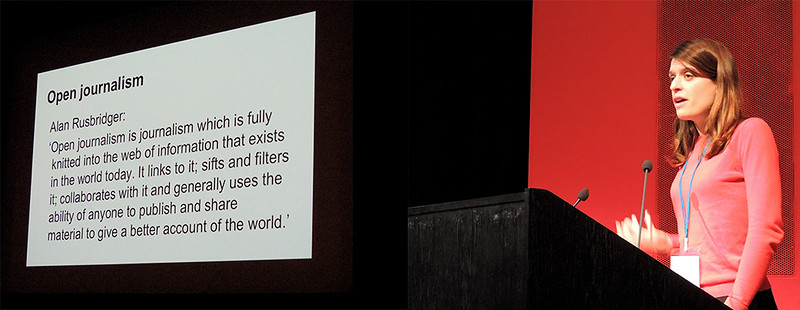 |
| Hannah Freeman, Guardian Community coordinator for culture at UKMW13. Photo: Andrew Lewis |
 |
| Michael John Gorman, The Ablative Museum |
Possible principles for 'the open museum'?
While the theme of the day was the power of participation, I've found myself reflecting more on the organisational challenges this creates. Below are the Guardian's 10 principles of open journalism. As many of the presentations at UKMW13 proved, museums are already doing some of these, but which others could be adapted to help museums deal with the challenges they face now and in the future?
- It encourages participation. It invites and/or allows a response
- It is not an inert, "us" or "them", form of publishing
- It encourages others to initiate debate, publish material or make suggestions. We can follow, as well as lead. We can involve others in the pre-publication processes
- It helps form communities of joint interest around subjects, issues or individuals
- It is open to the web and is part of it. It links to, and collaborates with, other material (including services) on the web
- It aggregates and/or curates the work of others
- It recognizes that journalists are not the only voices of authority, expertise and interest
- It aspires to achieve, and reflect, diversity as well as promoting shared values
- It recognizes that publishing can be the beginning of the journalistic process rather than the end
- It is transparent and open to challenge – including correction, clarification and addition
A related question that arose from Hannah's talk - are museums now in the media business, like it or not? And if our audiences expect museums to be media providers, how do we manage those expectations? (For an alternative model, read David Weinberger's Library as Platform.)
Emerging themes from UKMW13
I've already posted my opening notes for Museums on the Web 2013: 'Power to the people' but I want to go back to two questions I was poking around there: 'how can technologists share our knowledge and experience with others?', and 'why isn't the innovation we know happens in museum technology reflected in reports like last week's 'Digital Culture: How arts and cultural organisations in England use technology'? (Or, indeed, in the genre of patronising articles and blog posts hectoring museums for not using technology.) This seems more relevant than I thought it would be in 2013. Last year I was wondering how to define the membership of the Museums Computer Group when everyone in museums was a bit computer-y, but maybe broad digital literacy and comfort with technology-lead changes in museum practice is further off than I thought. (See also Rachel Coldicutt's 'I Say “Digital!”, You Say “Culture!”'). How do we bridge the gap? Is it just a matter of helping every museum go through the conversations necessary to create a digital strategy and come out the other side? And whose job is it to help museum staff learn how to manage public engagement, ecommerce, procurement, hiring when the digital world changes so quickly?
Another big theme was a reminder of how much is possible when you have technical expertise on hand to translate all the brilliant ideas museums have into prototypes or full products. At one point I jokingly tweeted that the museum and heritage sector would make huge leaps if we could just clone Jim O'Donnell (or the BBC's R&D staff). Perhaps part of the 'museums are digitally innovative'/'museums suck at digital' paradox is that technologists can see the potential of projects and assume that a new standard has been set, but it takes a lot more time and work to get them integrated into mainstream museum practice. Part of this may be because museums struggle to hire and keep really good developers, and don't give their developers the time or headspace to play and innovate. (Probably one reason I like hackdays - it's rare to get time to try new things when there is more worthy work than there is developer/technologist time - being inspired at conferences only goes so far when you can't find a bit of server space and a free day to try something out.) This has also been a theme at the first day at MCN2013, from what I've seen on twitter/webcasts from afar, so it's not only about the budget cuts in the UK. The Digital Culture report suggests that it may also be because senior management in museums don't know how to value 'digital experimentation'?
Other, more positive, themes emerged to link various presentations during the day. Community engagement can be hugely rewarding, but it takes resources - mostly staff time - to provide a conduit between the public and the organisation. It also takes a new mindset for content creators, whether journalists, educators or curators to follow the crowds' lead, but it can be rewarding, whether it's getting help identifying images from 'armchair archaeologists', working with online music communities to save their memories before they're lost to living memory or representing residents experiences of their city. Both presenters and the audience were quick to raise questions about the ethics of participatory projects and the wider implications of content/item collecting projects and citizen history.
Open content enables good things to happen. Digital platforms are great at connecting people, but in-person meetups and conversations are still special.
Finally, one way or another the audience will shape your projects to their own ends, and the audience proved it that day by taking to twitter to continue playing Curate-a-Fact between tea breaks.
We should have a proper archive of all the #UKMW13 tweets at some point, but in the meantime, here's a quick storify for MCG's Museums on the Web 2013: Power to the people. Oh, and thank you, thank you, thank you to all the wonderful people who helped the day come together.
Saturday, 16 November 2013
Opening notes for Museums on the Web 2013: 'Power to the people'
It'll take me a few days to digest the wonderfulness that was MCG's UK Museums on the Web 2013: 'Power to the people', so in lieu of a summary, here are my opening notes for the conference... (With the caveat that I didn't read this but still hopefully hit most of these points on the day).
Welcome to Museums on the Web 2013! I'm Mia Ridge, Chair of the Museums Computer Group.
Hopefully the game that began at registration has helped introduce you to some people you hadn't met before...You can vote on the game in the auditorium over the lunch break, and the winning team will be announced before the afternoon tea break. Part of being a welcoming community is welcoming others, so we tried to make it easier to start conversations. If you see someone who maybe doesn't know other people at the event, say hi. I know that many of you can feel like you're working alone, even within a big organisation, so use this time to connect with your peers.
This week saw the launch of a report written for Nesta, the Arts Council, and the Arts and Humanities Research Council in relation to the Digital R&D Fund for the Arts, 'Digital Culture: How arts and cultural organisations in England use technology'. One line in the report stood out: 'Museums are less likely than the rest of the sector to report positive impacts from digital technologies' - which seems counter-intuitive given what I know of museums making their websites and social media work for them, and the many exciting and effective projects we've heard about over the past twelve years of MCG's UK Museums on the Web conferences (and on our active discussion list).
The key to that paradox may lie in another statement in the report: museums report 'lower than average levels of digital expertise and empowerment from their senior management and a lower than average focus on digital experimentation, and research and development'.* (It may also be that a lot of museum work doesn't fit into an arts model, but that's a conversation for another day.) Today's theme almost anticipates this - our call for papers around 'Power to the people' asked for responses around the rise of director-level digital posts the rise of director-level digital posts and empowering museum staff to learn through play as well as papers on grassroots projects and the power of embedding digital audience participation and engagement into the overall public engagement strategy for a museum.
Today we'll be hearing about great projects from museums and a range of other organisations, but reports like this - and perhaps the wider issue of whether senior management and funders understand the potential of digital beyond new forms of broadcast and ticket sales - raises the question of whether we're preaching to the converted. How can we help others in museums benefit from the hard-won wisdom and lessons you'll hear today?
The Museums Computer Group has always been a platform for people working with museum technology who want to create positive change in the sector: our motto is 'connect, support, inspire', and we're always keen to hear your ideas about how we can help you connect, support and inspire you, but as a group we should also be asking: how can we share our knowledge and experience with others? It can be difficult to connect with and support others when you're flat out with your own work, yet the need to scale up the kinds of education we might have done with small groups working on digital projects is becoming more urgent as audience expectations change and resources need to be spent even more carefully. Ultimately we can help each other by helping the sector get better at technology and recognise the different types of expertise already available within the heritage sector. Groups like the MCG can help bridge the gap; we need your voices to reach senior management as well as practitioners and those who want to work with museums who'll shape the sector in the future.
It's rare to find a group so willing to share their failures alongside their successes, so willing to generously share their expertise and so keen to find lessons in other sectors. We appreciate the contributions of many of you who've spoken honestly about the successes and failures of your projects in the past, and applaud the spirit of constructive conversation that encourages your peers to share so openly and honestly with us. I'm looking forward to learning from you all today.
* Update to add a link to an interview with MTM's Richard Ellis who co-authored the Nesta report, who says the 'sheer extent of the divide between those in the know and those not' was one of the biggest surprises working in the culture sector.
Welcome to Museums on the Web 2013! I'm Mia Ridge, Chair of the Museums Computer Group.
Hopefully the game that began at registration has helped introduce you to some people you hadn't met before...You can vote on the game in the auditorium over the lunch break, and the winning team will be announced before the afternoon tea break. Part of being a welcoming community is welcoming others, so we tried to make it easier to start conversations. If you see someone who maybe doesn't know other people at the event, say hi. I know that many of you can feel like you're working alone, even within a big organisation, so use this time to connect with your peers.
This week saw the launch of a report written for Nesta, the Arts Council, and the Arts and Humanities Research Council in relation to the Digital R&D Fund for the Arts, 'Digital Culture: How arts and cultural organisations in England use technology'. One line in the report stood out: 'Museums are less likely than the rest of the sector to report positive impacts from digital technologies' - which seems counter-intuitive given what I know of museums making their websites and social media work for them, and the many exciting and effective projects we've heard about over the past twelve years of MCG's UK Museums on the Web conferences (and on our active discussion list).
The key to that paradox may lie in another statement in the report: museums report 'lower than average levels of digital expertise and empowerment from their senior management and a lower than average focus on digital experimentation, and research and development'.* (It may also be that a lot of museum work doesn't fit into an arts model, but that's a conversation for another day.) Today's theme almost anticipates this - our call for papers around 'Power to the people' asked for responses around the rise of director-level digital posts the rise of director-level digital posts and empowering museum staff to learn through play as well as papers on grassroots projects and the power of embedding digital audience participation and engagement into the overall public engagement strategy for a museum.
Today we'll be hearing about great projects from museums and a range of other organisations, but reports like this - and perhaps the wider issue of whether senior management and funders understand the potential of digital beyond new forms of broadcast and ticket sales - raises the question of whether we're preaching to the converted. How can we help others in museums benefit from the hard-won wisdom and lessons you'll hear today?
The Museums Computer Group has always been a platform for people working with museum technology who want to create positive change in the sector: our motto is 'connect, support, inspire', and we're always keen to hear your ideas about how we can help you connect, support and inspire you, but as a group we should also be asking: how can we share our knowledge and experience with others? It can be difficult to connect with and support others when you're flat out with your own work, yet the need to scale up the kinds of education we might have done with small groups working on digital projects is becoming more urgent as audience expectations change and resources need to be spent even more carefully. Ultimately we can help each other by helping the sector get better at technology and recognise the different types of expertise already available within the heritage sector. Groups like the MCG can help bridge the gap; we need your voices to reach senior management as well as practitioners and those who want to work with museums who'll shape the sector in the future.
It's rare to find a group so willing to share their failures alongside their successes, so willing to generously share their expertise and so keen to find lessons in other sectors. We appreciate the contributions of many of you who've spoken honestly about the successes and failures of your projects in the past, and applaud the spirit of constructive conversation that encourages your peers to share so openly and honestly with us. I'm looking forward to learning from you all today.
* Update to add a link to an interview with MTM's Richard Ellis who co-authored the Nesta report, who says the 'sheer extent of the divide between those in the know and those not' was one of the biggest surprises working in the culture sector.
Wednesday, 18 September 2013
Lighting beacons: research software engineers event and related topics
I've realised that it could be useful to share my reading at the intersection of research software engineers/cultural heritage technologist/digital humanities, so at the end I've posted some links to current discussions or useful reference points and work to provide pointers to interesting work.
But first; notes from last week's workshop for research software engineers, an event for people who 'not only develop the software, they also understand the research that it makes possible'. The organisers did a great job with the structure (and provided clear instructions on running a breakout session) - each unconference-style session had to appoint a scribe and report back to a plenary session as well as posting their notes to the group's discussion list so there's an instant archive of the event.
Discussions included:
I'd written about the event before I went (in Beyond code monkeys: recognising technologists' intellectual contributions, which relates it to digital humanities and cultural heritage work) but until I was there I hadn't realised the extra challenges RSEs in science face - unlike museum technologists, science RSEs are deeply embedded in a huge variety of disciplines and can't easily swap between them.
The event was a great chance to meet people facing similar issues in their work and careers, and showed how incredibly useful the right label can be for building a community. If you work with science+software in the UK and want to help work out what a research software engineer community might be, join in the RSE discussion.
If you're reading this post, you might also be interested in:
But first; notes from last week's workshop for research software engineers, an event for people who 'not only develop the software, they also understand the research that it makes possible'. The organisers did a great job with the structure (and provided clear instructions on running a breakout session) - each unconference-style session had to appoint a scribe and report back to a plenary session as well as posting their notes to the group's discussion list so there's an instant archive of the event.
Discussions included:
- How do you manage quality and standards in training - how do you make sure people are doing their work properly, and what are the core competencies and practices of an RSE?
- How should the research community recognise the work of RSEs?
- Sharing Research Software
- Routes into research software development - why did you choose to be an RSE?
- Do we need a RSE community?
- and the closing report from the Steering Committee and group discussion on what an RSE community might be or do.
I'd written about the event before I went (in Beyond code monkeys: recognising technologists' intellectual contributions, which relates it to digital humanities and cultural heritage work) but until I was there I hadn't realised the extra challenges RSEs in science face - unlike museum technologists, science RSEs are deeply embedded in a huge variety of disciplines and can't easily swap between them.
The event was a great chance to meet people facing similar issues in their work and careers, and showed how incredibly useful the right label can be for building a community. If you work with science+software in the UK and want to help work out what a research software engineer community might be, join in the RSE discussion.
If you're reading this post, you might also be interested in:
- Paul Walk's 2011 posts on The Strategic Developer: How Local Developers Can Make A Difference and The Value of Local Developers raised many of the issues discussed at the RSE event and the DevCSI ('Developer Community Supporting Innovation') initiative. There's also a Developer Contact Google Group.
- On Ant-Lions and Scholar-Programmers by Doug Reside - the emphasis is on scholars rather than programmers and it's also interesting for the differences between academia in the US and UK (though it doesn't directly address them)
- Alan Liu's "Why I'm In It" x 2 – Antiphonal Response to Stephan Ramsay on Digital Humanities and Cultural Criticism and Stephen Ramsey's 'Why I'm In It' - if you haven't been keeping up with the digital humanities, dive into the deep end here.
- Michael Widner's Towards a Front Page for the Digital Humanities #dhthis, because it's one of many posts discussing DHThis and because I forget that not everyone lives and breaths this: 'software is a form of writing/making with its own assumptions and affordances, we have a responsibility to critique the software'
 |
| In ye olden days, beacon fires were lit on hills to send signals between distant locations. These days we have blogs. |
Sunday, 25 August 2013
Beyond code monkeys: recognising technologists' intellectual contributions
Two upcoming events suggest that academia is starting to recognise that specialist technologists - AKA 'research software engineers' or 'digital humanities software developers' - make intellectual contributions to research software, and further, that it is starting to realise the cost of not recognising them. In the UK, there's a 'workshop for research software engineers' on September 11; in the US there's Speaking in Code in November (which offers travel bursaries and is with ace people, so do consider applying).
But first, who are these specialist technologists, and why does it matter? The UK Software Sustainability Institute's 'workshop for research software engineers' says 'research software engineers ... not only develop the software, they also understand the research that it makes possible'. In an earlier post, The Craftsperson and the Scholar, UCL's James Hetherington says a 'good scientific coder combines two characters: the scholar and the craftsperson'. Research software needs people who are both scholar - 'the archetypical researcher who is driven by a desire to understand things to their fullest capability' and craftsperson who 'desires to create and leave behind an artefact which reifies their efforts in a field': 'if you get your kicks from understanding the complex and then making a robust, clear and efficient tool, you should consider becoming a research software engineer'. A supporting piece in the Times Higher Education, 'Save your work – give software engineers a career track' points out that good developers can leave for more rewarding industries, and raises one of the key issues for engineers: not everyone wants to publish academic papers on their development work, but if they don't publish, academia doesn't know how to judge the quality of their work.
Over in the US, and with a focus on the humanities rather than science, the Scholar's Lab is running the 'Speaking in Code' symposium to highlight 'what is almost always tacitly expressed in our work: expert knowledge about the intellectual and interpretive dimensions of DH code-craft, and unspoken understandings about the relation of that work to ethics, scholarly method, and humanities theory'. In a related article, Devising New Roles for Scholars Who Can Code, Bethany Nowviskie of the Scholar's Lab discussed some of the difficulties in helping developers have their work recognised as scholarship rather than 'service work' or just 'building the plumbing':
Digital humanists spend a lot of time thinking about the role of 'making things' in the digital humanities but, to cross over to my other domain of interest, I think the international Museums and the Web conference's requirement for full written papers for all presentations has helped more museum technologists translate some of their tacit knowledge into written form. Everyone who wants to present their work has to find a way to write up their work, even if it's painful at the time - but once it's done, they're published as open access papers well before the conference. Museum technologists also tend to blog and discuss their work on mailing lists, which provides more opportunities to tease out tacit knowledge while creating a visible community of practice.
I wasn't at Museums and the Web 2013 but one of the sessions I was most interested in was Rich Cherry and Rob Stein's 'What’s a Museum Technologist today?' as they were going to report on the results of a survey they ran earlier this year to come up with 'a more current and useful description of our profession'. (If you're interested in the topic, my earlier posts on museum technologists include On 'cultural heritage technologists', Confluence on digital channels; technologists and organisational change?, Museum technologists redux: it's not about us, Survey results: issues facing museum technologists.) Rob's posted their slides at What is a Museum Technologist Anyway? and I'd definitely recommend you go check them out. Looking through the responses, the term 'museum technologist' seems to have broadened as more museum jobs involve creating content for or publishing on digital channels (whether web sites, mobile apps, ebooks or social media), but to me, a museum technologist isn't just someone who uses technology or social media - rather, there's a level of expertise or 'domain knowledge' across both museums and technology - and the articles above have reinforced my view that there's something unique in working so deeply across two or more disciplines. (Just to be clear: this isn't a diss for people who use social media rather than build things - there's also a world of expertise in creating content for the web and social media). Or to paraphrase James Hetherington, ''if you get your kicks from understanding the complex and then making a robust, clear and efficient tool, you should consider becoming a museum technologist'.
To further complicate things, not everyone needs their work to reflect all their interests - some programmers and tech staff are happy to leave their other interests outside the office door, and leave engineering behind at the end of the day - and my recent experiences at One Week | One Tool reminded me that promiscuous interdisciplinarity can be tricky. Even when you revel in it, it's hard to remember that people wear multiple hats and can swap from production-mode to critically reflecting on the product through their other disciplinary lenses, so I have some sympathy for academics who wonder why their engineer expects their views on the relevant research topic to be heard. That said, hopefully events like these will help the research community work out appropriate ways of recognising and rewarding the contributions of researcher developers.
[Update, September 2013: I've posted brief notes and links to session reports from the research software engineers event at Lighting signals: research software engineers event and related topics.]
But first, who are these specialist technologists, and why does it matter? The UK Software Sustainability Institute's 'workshop for research software engineers' says 'research software engineers ... not only develop the software, they also understand the research that it makes possible'. In an earlier post, The Craftsperson and the Scholar, UCL's James Hetherington says a 'good scientific coder combines two characters: the scholar and the craftsperson'. Research software needs people who are both scholar - 'the archetypical researcher who is driven by a desire to understand things to their fullest capability' and craftsperson who 'desires to create and leave behind an artefact which reifies their efforts in a field': 'if you get your kicks from understanding the complex and then making a robust, clear and efficient tool, you should consider becoming a research software engineer'. A supporting piece in the Times Higher Education, 'Save your work – give software engineers a career track' points out that good developers can leave for more rewarding industries, and raises one of the key issues for engineers: not everyone wants to publish academic papers on their development work, but if they don't publish, academia doesn't know how to judge the quality of their work.
Over in the US, and with a focus on the humanities rather than science, the Scholar's Lab is running the 'Speaking in Code' symposium to highlight 'what is almost always tacitly expressed in our work: expert knowledge about the intellectual and interpretive dimensions of DH code-craft, and unspoken understandings about the relation of that work to ethics, scholarly method, and humanities theory'. In a related article, Devising New Roles for Scholars Who Can Code, Bethany Nowviskie of the Scholar's Lab discussed some of the difficulties in helping developers have their work recognised as scholarship rather than 'service work' or just 'building the plumbing':
"I have spent so much of my career working with software developers who are attached to humanities projects," she says. "Most have higher degrees in their disciplines." Unlike their professorial peers, though, they aren't trained to "unpack" their thinking in seminars and scholarly papers. "I've spent enough time working with them to understand that a lot of the intellectual codework goes unspoken," she says.
 |
| Women at work on C-47 Douglas cargo transport. LOC image via Serendip-o-matic |
I wasn't at Museums and the Web 2013 but one of the sessions I was most interested in was Rich Cherry and Rob Stein's 'What’s a Museum Technologist today?' as they were going to report on the results of a survey they ran earlier this year to come up with 'a more current and useful description of our profession'. (If you're interested in the topic, my earlier posts on museum technologists include On 'cultural heritage technologists', Confluence on digital channels; technologists and organisational change?, Museum technologists redux: it's not about us, Survey results: issues facing museum technologists.) Rob's posted their slides at What is a Museum Technologist Anyway? and I'd definitely recommend you go check them out. Looking through the responses, the term 'museum technologist' seems to have broadened as more museum jobs involve creating content for or publishing on digital channels (whether web sites, mobile apps, ebooks or social media), but to me, a museum technologist isn't just someone who uses technology or social media - rather, there's a level of expertise or 'domain knowledge' across both museums and technology - and the articles above have reinforced my view that there's something unique in working so deeply across two or more disciplines. (Just to be clear: this isn't a diss for people who use social media rather than build things - there's also a world of expertise in creating content for the web and social media). Or to paraphrase James Hetherington, ''if you get your kicks from understanding the complex and then making a robust, clear and efficient tool, you should consider becoming a museum technologist'.
To further complicate things, not everyone needs their work to reflect all their interests - some programmers and tech staff are happy to leave their other interests outside the office door, and leave engineering behind at the end of the day - and my recent experiences at One Week | One Tool reminded me that promiscuous interdisciplinarity can be tricky. Even when you revel in it, it's hard to remember that people wear multiple hats and can swap from production-mode to critically reflecting on the product through their other disciplinary lenses, so I have some sympathy for academics who wonder why their engineer expects their views on the relevant research topic to be heard. That said, hopefully events like these will help the research community work out appropriate ways of recognising and rewarding the contributions of researcher developers.
[Update, September 2013: I've posted brief notes and links to session reports from the research software engineers event at Lighting signals: research software engineers event and related topics.]
Saturday, 5 January 2013
Keeping corridors clear of dragons (on agency and digital humanities tools)
A while ago I posted 'Reflections on teaching Neatline', which was really about growing pains in the digital humanities. I closed by asking 'how do you balance the need for fast-moving innovative work-in-progress to be a bit hacky and untidy around the edges with the desires of a wider group of digital humanities-curious scholars [for stable, easy-to-use software]? Is it ok to say 'here be dragons, enter at your own risk'?' Looking back, I started thinking about this in terms of museum technologists (in Museum technologists redux: it's not about us) but there I was largely thinking of audiences, and slightly less of colleagues within museums or academia. I'm still not sure if this is a blog post or just an extended comment on those post, but either way, this is an instance of posting-as-thinking.
Bethany Nowviskie has problematised and contextualised some of these issues in the digital humanities far more elegantly for an invited talk at the MLA 2013 conference. You should go read the whole thing at resistance in the materials, but I want to quickly highlight some of her points here.
She quotes William Morris: '...you can’t have art without resistance in the material. No! The very slowness with which the pen or the brush moves over the paper, or the graver goes through the wood, has its value. And it seems to me, too, that with a machine, one’s mind would be apt to be taken off the work at whiles by the machine sticking or what not' and discusses her realisation that:
"Morris’s final, throwaway complaint is not about that positive, inherent resistance—the friction that makes art—which we happily seek within the humanities material we practice upon. It’s about resistance unhealthily and inaccessibly located in a toolset. ... precisely this kind of disenfranchising resistance is the one most felt by scholars and students new to the digital humanities. Evidence of friction in the means, rather than the materials, of digital humanities inquiry is everywhere evident."And she includes an important call to action for digital humanities technologists: "we diminish our responsibility to address this frustration by naming it the inevitable “learning curve” of the digital humanities. Instead, we might confess that among the chief barriers to entry are poorly engineered and ineptly designed research tools and social systems". Her paper is also a call for a more nuanced understanding and greater empathy from tool-builders toward those who are disenfranchised by tools they didn't create and can't hack to fit their needs. It's too easy to forget that an application or toolset that looks like something I can happily pick up and play with to make it my own may well look as unfathomable and un-interrogable as the case of a mobile phone to someone else.
Digital humanities is no longer a cosy clubhouse, which can be uncomfortable for people who'd finally found an academic space where they felt at home. But DH is also causing discomfort for other scholars as it encroaches on the wider humanities, whether it's as a funding buzzword, as a generator of tools and theory, or as a mode of dialogue. This discomfort can only be exacerbated by the speed of change, but I suspect that fear of the unknown demands of DH methods or anxiety about the mental capabilities required are even more powerful*. (And some of it is no doubt a reaction to the looming sense of yet another thing to somehow find time to figure out.) As Sharon Leon points out in 'Digital Methods for Mid-Career Avoiders?', digital historians are generally 'at home with the sense of uncomfortableness and risk of learning new methods and approaches' and can cope with 'a feeling of being at sea while figuring out something completely new', while conversely 'this kind of discomfort is simply to overwhelming for historians who are defined by being the expert in their field, being the most knowledgable, being the person who critiques the shortfalls of the work of others'.
In reflecting on March 2012's Digital Humanities Australasia and the events and conversations I've been part of over the last year, it seems that we need ways of characterising the difference between scholars using digital methods and materials to increase their productivity (swapping card catalogues for online libraries, or type-writers for Word) without fundamentally interrogating their new working practices, and those who charge ahead, inventing tools and methods to meet their needs. It should go without saying that any characterisations should not unfairly or pejoratively label either group (and those in-between).
Going beyond the tricky 'on-boarding' moments I talked about in 'Reflections on teaching Neatline', digital humanities must consider the effect of personal agency in relation to technology, issues in wider society that affect access to 'hack' skills and what should be done to make the tools, or the means, of DH scholarship more accessible and transparent. Growing pains are one thing, and we can probably all sympathise with an awkward teenage phase, but as digital humanities matures as a field, it's time to accept our responsibility for the environment we're creating for other scholars. Dragons are fine in the far reaches of the map where the adventurous are expecting them, but they shouldn't be encountered in the office corridor by someone who only wanted to get some work done.
* Since posting this, I've read Stephen Ramsey's 'The Hot Thing', which expresses more anxieties about DH than I've glanced at here: 'Digital humanities is the hottest thing in the humanities. ... So it is meet and good that we talk about this hot thing. But the question is this: Are you hot?'. But even here, do technologists and the like have an advantage? I'm used to (if not reconciled to) the idea that every few years I'll have to learn another programming language and new design paradigms just to keep up; but even I'm glad I don't have to keep up with the number of frameworks that front-end web developers have to, so perhaps not?
Sunday, 11 November 2012
'Go digital' at Museums Association 2012 Conference
Some people who couldn't make the Museums Association conference (or #museums2012) asked for more information on the session on digital strategies, so here are my introductory remarks and some scribbled highlights of the speakers' papers and discussion with the audience.
Update: a year later, I've thought of a 'too long, didn't read' version: digital strategies are like puberty. Everyone has to go through it, but life's better on the other side when you've figured things out. Digital should be incorporated into engagement, collections, venue etc strategies - it's not a thing on its own.
The speakers were Carolyn Royston (@caro_ft), Head of New Media at Imperial War Museum; Hugh Wallace (@tumshie), Head of Digital Media at National Museums Scotland; Michael Woodward (@michael1665), Commercial Director at York Museums Trust, and I chaired the session in my role as Chair of the Museums Computer Group. From the conference programme: 'This session explores the importance of developing a digital strategy. It will provide insight into how organisations can incorporate digital into a holistic approach that meets wider organisational and public engagement objectives and look at how to use digital engagement as a catalyst to drive organisational change.'
Update: a year later, I've thought of a 'too long, didn't read' version: digital strategies are like puberty. Everyone has to go through it, but life's better on the other side when you've figured things out. Digital should be incorporated into engagement, collections, venue etc strategies - it's not a thing on its own.
The speakers were Carolyn Royston (@caro_ft), Head of New Media at Imperial War Museum; Hugh Wallace (@tumshie), Head of Digital Media at National Museums Scotland; Michael Woodward (@michael1665), Commercial Director at York Museums Trust, and I chaired the session in my role as Chair of the Museums Computer Group. From the conference programme: 'This session explores the importance of developing a digital strategy. It will provide insight into how organisations can incorporate digital into a holistic approach that meets wider organisational and public engagement objectives and look at how to use digital engagement as a catalyst to drive organisational change.'
After various conversations about digital and museums with people who were interested in the session, I updated my introduction so that overall the challenge of embracing the impact of digital technologies, platforms and audiences on museums was put in a positive light. The edited title that appeared in the programme had a different emphasis ('Go digital' rather than the 'Getting strategic about digital' we submitted) so I wanted it to be clear that we weren't pushing a digital agenda for the sake of technology itself. Or as I apparently said at the time, "it's not about making everything digital, it's about dealing with the fact that digital is everywhere".
I started by asking people to raise their hands if their museum had a digital strategy, and I'd say well over half the room responded, which surprised me. Perhaps a third were in the process of planning for a digital strategy and just a few were yet to start at all.
My notes were something like this: "we probably all know by now that digital technologies bring wonderful opportunities for museums and their audiences, but you might also be worried about the impact of technology on audiences and your museum. ‘Digital’ varies in organisations – it might encompass social media, collections, mobile, marketing, in-gallery interactives, broadcast and content production. It touches every public-facing output of the museum as well as back-office functions and infrastructure.
You can’t avoid the impact of digital on your organisation, so it’s about how you deal with it, how you integrate it into the fabric of your museum. As you’ll hear in the case studies, implementing digital strategy itself changes the organisation, so from the moment you start talking to people about devising a digital strategy, you'll be making progress. For some of our presenters, their digital strategy ultimately took the form of a digital vision document – the strategy itself is embedded in the process and in the resulting framework for working across the organisation. A digital strategy framework allows you to explore options in conversation with the whole organisation, it’s not about making everything digital.
Our case studies come from three very different organisations working with different collections in different contexts. Mike, Commercial Director at York Museums Trust will talk about planning the journey, moving from ad hoc work to making digital integral to how the organisation works; Hugh, Head of Digital Media at National Museums Scotland will discuss the process they went through to develop digital strategy, what’s worked and what hasn’t’; Carolyn Royston, Head of Digital Media at Imperial War Museums, who comes from a learning background, will talk from IWM’s digital adventure, from where they started to where they are now. They’re each at different stages of the process of implementing and living with a digital strategy.
Based on our discussions as we planned this session, the life cycle of a digital strategy in a museum seems to be: aspiration, design, education and internal outreach, integration with other strategies (particularly public engagement) and sign off... then take a deep breath, look at what the ripple effect has been and start updating your strategies as everything will have changed since you started. And with that, over to Mike..."
Mike talked about working out when digital delivery really makes sense, whether for inaccessible objects (like a rock on Mars) or a delicate book; the major role that outreach and communication play in the process of creating a digital strategy; appointing the staff that would deliver it based on eagerness, enthusiasm and teamwork rather than pure tech skills; where digital teams should sit in the organisation; and about the possibility of using digital volunteers (or 'armchair experts') to get content online.
Hugh went for 'frameworks, not fireworks', pointing out that what happens after the strategy is written is important so you need to create a flexible framework to manage the inevitable change. He discussed the importance of asking the right-sized question (as in one case, where 'we didn't know at the start that an app would be the answer') and working on getting digital into 'business as usual' rather than an add-on team with specialist skills. Or as one tweeter summarised, 'work across depts, don't get hung up on the latest tech, define users realistically and keep it simple'.
Carolyn covered the different forms of digital engagement and social media the IWM have been trying and the role of creating their digital vision in helping overcome their fears; the benefits of partnerships with other organisations for piggybacking on their technology, networks and audiences, and the fact that their collections sales have gone up as a result of opening up their collections. In the questions, someone described intellectual property restrictions to try to monetise collections as 'fool's gold' - great term! I think we should have a whole conference session on this sometime soon.
When reviewing our discussions beforehand I'd found a note from a planning call which summed up how much the process should change the organisation: 'if you're not embarrassed by your digital strategy six months after sign-off you probably haven't done it right', and on the day the speakers reinforced my impression that ultimately, devising and implementing a digital strategy is (probably) a necessary process to go through but it's not a goal in its own right. The IWM and NMS examples show that the internal education and conversations can both create a bigger appetite for digital engagement and change organisational expectations around digital to the point where it has to be more widely integrated. The best place for a digital strategy is within a public engagement strategy that integrates the use of digital platforms and working methods into the overall public-facing work of the museum.
Listening to the speakers, a new metaphor occurred to me: is implementing a digital strategy like gardening? It needs constant care and feeding after the big job of sowing seeds is over. And much like gardening for pleasure (in the UK, anyway), the process may have more impact than the product.
And something I didn't articulate at the time - if the whole museum is going to be doing some digital work, we technologists are going to have to be patient and generous in sharing our knowledge and helping everyone learn how to make sensible decisions about digital content and experiences. If we don't, we risk being a bottleneck or forcing people to proceed based on guesswork and neither are good for museums or their audiences.
So much awesomeness! #GODIGITAL #Museums2012 twitter.com/dannybirchall/…Huge thanks for Carolyn, Hugh and Michael for making the whole thing such a pleasure and to the Museum Association conference organisers for the opportunity to share our thoughts and experiences.
— Danny Birchall (@dannybirchall) November 9, 2012
And finally, if you're interested in digital strategies in heritage organisations, the Museums Computer Groups annual Museums on the Web conference is all about being 'strategically digital' (which as you might have guessed from the above, sometimes might mean not using technology at all) but UKMW12 tickets are selling out fast, so don't delay.
Monday, 29 October 2012
'Behind-the-themes' at the UK Museums on the Web conference - UKMW12 'Strategically Digital'
Full disclosure: I'm the Chair of the Museums Computer Group, and in this case I also chaired the Programme Committee, but I think we've put together a really strong programme. I thought I'd provide some background here about where the themes came from. (Also, I'll take any excuse for a punning title.)
When putting together the themes, I reviewed reports from a number of international conferences and went through the archives of the MCG's mailing list to get a sense of the issues that were both bugging our members on a daily basis and having an impact on museums more generally. I've also spent time talking to staff in museums in Australia, New Zealand, Taiwan, the US and (of course) the UK and those conversations also informed the themes. I also referred back to the MCG Committee's discussions about our vision for 'MCG@30', which included supporting our members by advocating for their work at higher levels of the museum sector. Hopefully this event is part of this process, as is a session on 'digital strategy' at the Museums Association conference.
For me, being 'strategically digital' means the best solution for a project might not involve technology. Being 'strategically digital' offers some solutions to the organisational change issues raised by the mismatch between web speed and museum speed, and it means technology decisions should always refer back to a museum's public engagement strategy (or infrastructure plans for background ICT services).
Like our 'Engaging digital audiences in museums' Spring meeting that aimed to get museum technologists and educators talking and learning from each other, UKMW12 is about breaking out of our comfortable technology-focused bubble and making sure the goals and language of web and digital teams relate to the rest of the organisation; it's also about helping the rest of the museum understand your work. We've seen a range of people sign up for tickets so far, so hopefully the day will provide a chance for staff to understand more about the workings of their own museum as well as the museums presenting on the day. The conference is grounded in reality: our speakers address both successes and failures in digital strategies and organisational change. You can get a sneak preview of the range of discussion on the day at Andrew Dobson's post on '10 things I have learned working for Sky', Tate's Online Strategy or Caper on Happenstance, Simon Tanner's 'Balanced Value Impact Model' and of course through the talk abstracts in the programme. Some of our best Museums on the Web conferences have featured a similar mix of fresh voices from outside the sector and hard-won wisdom from within the sector, so I have high hopes for this event.
After some thought, a call for papers and the input of the wonderful 2012 Programme Committee (Ross Parry, Melissa Terras, Carolyn Royston and Stuart Dunn), this is the result:

On a personal note, this event will mark 30 years since the first ever Museums Computer Group event, and eight years since the first UK Museums on the Web conference - a milestone worth celebrating! If you'd like to be an active part of the MCG's future, we'll be electing new committee members in the lunchtime AGM on November 30. Get in touch if you're curious about how you could contribute...
When putting together the themes, I reviewed reports from a number of international conferences and went through the archives of the MCG's mailing list to get a sense of the issues that were both bugging our members on a daily basis and having an impact on museums more generally. I've also spent time talking to staff in museums in Australia, New Zealand, Taiwan, the US and (of course) the UK and those conversations also informed the themes. I also referred back to the MCG Committee's discussions about our vision for 'MCG@30', which included supporting our members by advocating for their work at higher levels of the museum sector. Hopefully this event is part of this process, as is a session on 'digital strategy' at the Museums Association conference.
For me, being 'strategically digital' means the best solution for a project might not involve technology. Being 'strategically digital' offers some solutions to the organisational change issues raised by the mismatch between web speed and museum speed, and it means technology decisions should always refer back to a museum's public engagement strategy (or infrastructure plans for background ICT services).
Like our 'Engaging digital audiences in museums' Spring meeting that aimed to get museum technologists and educators talking and learning from each other, UKMW12 is about breaking out of our comfortable technology-focused bubble and making sure the goals and language of web and digital teams relate to the rest of the organisation; it's also about helping the rest of the museum understand your work. We've seen a range of people sign up for tickets so far, so hopefully the day will provide a chance for staff to understand more about the workings of their own museum as well as the museums presenting on the day. The conference is grounded in reality: our speakers address both successes and failures in digital strategies and organisational change. You can get a sneak preview of the range of discussion on the day at Andrew Dobson's post on '10 things I have learned working for Sky', Tate's Online Strategy or Caper on Happenstance, Simon Tanner's 'Balanced Value Impact Model' and of course through the talk abstracts in the programme. Some of our best Museums on the Web conferences have featured a similar mix of fresh voices from outside the sector and hard-won wisdom from within the sector, so I have high hopes for this event.
After some thought, a call for papers and the input of the wonderful 2012 Programme Committee (Ross Parry, Melissa Terras, Carolyn Royston and Stuart Dunn), this is the result:

The Museums Computer Group's annual Museums on the Web conference – UKMW12 – will be held at the Wellcome Collection in London on 30 November 2012.
UKMW12 is about being ‘strategically digital’. Responding to the issues faced by museums today, it's an opportunity to take a step back from the everyday and think strategically about the impact of the digital revolution on your museum and on the sector as a whole, including themes such as: digitally enabling the modern museum and its staff; sustaining the digital agenda and the realities of digital strategies and organisational change; and the complexities of digital engagement and the impact of social media on audience expectations.
UKMW12 brings together speakers from organisations including the Tate, the V&A, UCL, King's College, the Guardian, Strategic Content Alliance, Collections Trust and Caper.
As always, UK Museums on the Web is a day for being inspired by the latest ideas, for learning from case studies grounded in organisations like yours, and for networking with other technologists, curators, managers, academics, learning and marketing specialists in the museum and heritage sector.
Don't miss out! Book your ticket now at http://ukmw12.eventbrite.co.ukIf you've never been (or haven't been for a while) to an MCG event, these posts link to several event reports from attendees and should give you an idea of who goes and what's discussed: Your blog posts and tweets about ‘Engaging digital audiences in museums’ (Spring 2012); UKMW11 Blog Posts (theme: The innovative museum: creating a brighter future); UK Museums on the Web 2010.
Find out more about the conference at http://bit.ly/ukmw12.
On a personal note, this event will mark 30 years since the first ever Museums Computer Group event, and eight years since the first UK Museums on the Web conference - a milestone worth celebrating! If you'd like to be an active part of the MCG's future, we'll be electing new committee members in the lunchtime AGM on November 30. Get in touch if you're curious about how you could contribute...
Saturday, 29 September 2012
Confluence on digital channels; technologists and organisational change?
I suspect this is a few posts in one, but bear with me as I think aloud...
Similarly, building websites, apps and social media entails a series of decisions that operationalise a museum's big 'vision' statements; but as these decisions are made on the fly, they're often again less strategic and more subject to the vagaries of the organisation. For technologists, there's often also a tension between wanting to ensure sensible digital decisions are made and not wanting to be a bottleneck in the long line of sign-off documents and meetings involved in museum projects (and I'm still not sure how best to resolve that, especially when it's easy to make the wrong choice but technology changes more quickly than most museums can train staff).
Museums seem to struggle when the quality of those decisions, and therefore the quality of the final product, rests in part on whether audience-focused experts in technology, content, and graphic and experience design are present and heard at critical points, even when their recommendations contradict those of more established voices.
So who can stand up to 'the way things have always been done' and inter-departmental bun fights and represent the needs of our audiences in technology projects? In museums there's often a perception that digital teams are a service department (perhaps because of their roots in IT departments) while digital teams see themselves as creative departments, commissioning content and design, producing innovative experiences and consulting within the museum on digital projects and audience needs as well as delivering technical solutions. Coming down on the side of web teams in 'Web teams need real authority' Paul Boag pronounced: "web teams should have the final say about what appears on the website. They should have the authority to reject content, remove out of date content and maintain editorial control". His post got such a huge response that he expanded on this in another article, 'Paul Boag: give web teams more authority', where he called for organisations to break out of entrenched working methods and "establish a separate web strategy that defines who owns the website, how it will be operated and how editorial decisions are made". He noted that successful websites aren't just about code, "it's also about helping bring about cultural change to allow better management of sites". While Claire Ross' experience with digital R&D in museums might be more intense than the usual museum digital project, it bears out my experience that (in the words of one senior digital manager) 'organisational change is one of the most important things about what we do' and that this changes needs to be supported by senior management to be truly effective.
The call for strategic decision-making about organisational websites (and by extension, other digital channels) isn't new but it might be getting to the point where we can't ignore it. In 2011 Jonathan Kahn wrote A List Apart article on 'Web Governance: Becoming an Agent of Change, noting that the "the website is now the digital manifestation of the organization" but that "the user experiences we deliver don’t meet our expectations [because] when it comes to the web, organizations are broken". The article proposes 'web governance' as a combination of web strategy, web governance, web execution, and web measurement. And it's not all doom and gloom – many organisations (museums included) are resolving issues around web governance and thriving in a digital environment. But what happens to museums that rely on old models and don't sort out web governance until it's too late?
As Kahn says:
[Edit to add: the Museums Computer Group has a call for papers for UK Museums on the Web 2012 on the theme of 'strategically digital' and you might want to submit a proposal soon if you've been working on these kinds of issues. Disclosure: I'm the MCG's Chair.]
I'm wondering if a better definition of museum technologist is someone who can appropriately apply a range of digital solutions to help meet the goals of a particular museum project. Even better, a museum technologist should be able to empathise with stakeholders enough to explain the implications of their technology choices for established internal work patterns and to contextualise them in relation to audience expectations. I guess this is also a reflection of the social changes the internet has brought - we geeks aren't immune from the need to change and adapt.
[Update, April 2013: I wonder what the answer would be if we asked other museum staff what they think a technologist should be? The role of 'translator' is valued by some project teams, but is the technologist always the best person for the job? If you're reading this before April 12 2013, you might want to take the survey 'What is a Museum Technologist anyway?' that Rob Stein and Rich Cherry have put together.]
--
If you liked this post, you may also be interested in Museums and iterative agility: do your ideas get oxygen? (21 November 2010) and A call for agile museum projects (a lunchtime manifesto) (10 March 2009).
There can be only one...
I'm fascinated with the idea that digital channels are the point where the various functions of a museum – marketing, research, collections, outreach, education, fundraising, etc – meet. (If you've worked in a museum for a while you've probably witnessed heated internal discussions about which departments can have prominent spots on the front page of a museum website, or about who runs the $MuseumName Twitter or Facebook accounts.) This confluence in digital channels hopefully encourages organisations to think about what content (and who) best represents them to the world - but I suspect that often it's less about the public engagement strategy and more about organisational history and politics.Similarly, building websites, apps and social media entails a series of decisions that operationalise a museum's big 'vision' statements; but as these decisions are made on the fly, they're often again less strategic and more subject to the vagaries of the organisation. For technologists, there's often also a tension between wanting to ensure sensible digital decisions are made and not wanting to be a bottleneck in the long line of sign-off documents and meetings involved in museum projects (and I'm still not sure how best to resolve that, especially when it's easy to make the wrong choice but technology changes more quickly than most museums can train staff).
Museums seem to struggle when the quality of those decisions, and therefore the quality of the final product, rests in part on whether audience-focused experts in technology, content, and graphic and experience design are present and heard at critical points, even when their recommendations contradict those of more established voices.
Why websites suck (or suck more than they should)
Building digital products means challenging 'the way things have always been done', and while museums-as-organisations are notoriously resistant to change, these definitional issues around the role of a digital team - technical delivery, content strategy, experience design, or some combination of the three - aren't unique to heritage organisations. Analytics guru Avinash Kaushik wrote: "I believe most websites suck because HiPPOs create them. HiPPO is an acronym for the 'Highest Paid Person's Opinion'. ... The HiPPO is a poor stand-in for what customers want". That's possibly putting it too strongly, but it seems that potentially interesting digital projects do fail to deliver on that potential more often than they should, and it's not only because museums are generally a long way from thinking 'digital first'.So who can stand up to 'the way things have always been done' and inter-departmental bun fights and represent the needs of our audiences in technology projects? In museums there's often a perception that digital teams are a service department (perhaps because of their roots in IT departments) while digital teams see themselves as creative departments, commissioning content and design, producing innovative experiences and consulting within the museum on digital projects and audience needs as well as delivering technical solutions. Coming down on the side of web teams in 'Web teams need real authority' Paul Boag pronounced: "web teams should have the final say about what appears on the website. They should have the authority to reject content, remove out of date content and maintain editorial control". His post got such a huge response that he expanded on this in another article, 'Paul Boag: give web teams more authority', where he called for organisations to break out of entrenched working methods and "establish a separate web strategy that defines who owns the website, how it will be operated and how editorial decisions are made". He noted that successful websites aren't just about code, "it's also about helping bring about cultural change to allow better management of sites". While Claire Ross' experience with digital R&D in museums might be more intense than the usual museum digital project, it bears out my experience that (in the words of one senior digital manager) 'organisational change is one of the most important things about what we do' and that this changes needs to be supported by senior management to be truly effective.
As Kahn says:
"The internet revolution has created huge social change: it’s changed the way people relate to organizations and it’s already destroyed several once-mighty industries, like newspapers, travel agents, and music publishing. Although we’re comfortable with the idea that the web is critical to organizations, we often miss the corollary: the web has changed the way organizations operate, and in many cases it’s changed their business models, too. When executives can’t see that, it causes a crisis. Welcome to your daily web-making reality."Sound familiar?
And therefore, museum technologists need to step up...
A while ago, I had one of those epiphanies that occur in random conversations when I realised that my views as a technologists are informed more by my experience as a business analyst and user experience researcher than my time as a programmer: for me, being a technologist is not (only) about knowing how to cut code, it's about years of sitting in a room listening to people describe their problems, abstracting and analysing them to understand the problem space and thinking about how technology-driven change fits in that particular context.I'm wondering if a better definition of museum technologist is someone who can appropriately apply a range of digital solutions to help meet the goals of a particular museum project. Even better, a museum technologist should be able to empathise with stakeholders enough to explain the implications of their technology choices for established internal work patterns and to contextualise them in relation to audience expectations. I guess this is also a reflection of the social changes the internet has brought - we geeks aren't immune from the need to change and adapt.
[Update, April 2013: I wonder what the answer would be if we asked other museum staff what they think a technologist should be? The role of 'translator' is valued by some project teams, but is the technologist always the best person for the job? If you're reading this before April 12 2013, you might want to take the survey 'What is a Museum Technologist anyway?' that Rob Stein and Rich Cherry have put together.]
--
If you liked this post, you may also be interested in Museums and iterative agility: do your ideas get oxygen? (21 November 2010) and A call for agile museum projects (a lunchtime manifesto) (10 March 2009).
Saturday, 14 July 2012
Both technologist and humanist in the academic digital humanities?
I've been reading Andrew Prescott's excellent Making the Digital Human: Anxieties, Possibilities, Challenges:
Beyond the question of how and why digital people are pushed into support roles in digital humanities projects, I've also been wondering whether the academic world actually allows one to simultaneously be a technologist and a humanist. This is partly because I'm still mulling over the interactions between different disciplines at a recent research institute and partly because of a comment about a recently advertised 'digital historian' job that called it "'Digital Historian' as slave to real thing - no tenure, no topic, no future".
The statement 'no topic' particularly stood out. I'm not asking whether it's possible for someone to be a good historian and a good programmer (for example) because clearly some people are both, but rather whether hiring, funding, training and academic structures allow one to be both technologist and humanist. Can one propose both a data architecture and a research question?
It may simply be that people with specialist skills are leant on heavily in a project because their skills are vital for its success, but does this mean an individual is corralled into one type of work to the exclusion of others? If you are the only programmer-historian in a group of historians, do you only get to be a programmer, and vice versa? Are there academic roles that truly make the most of both aspects of the humanist technologist?
And does this mean, as Prescott says, that 'intellectually, the digital humanities is always reactive'?
...in Britain the problem is I think that the digital humanities has failed to develop its own distinctive intellectual agendas and is still to all intents and purposes a support service. The digital humanities in Britain has generally emerged from information service units and has never fully escaped these origins. Even in units which are defined as academic departments, such as my own in King’s, the assumption generally is that the leading light in the project will be an academic in a conventional academic department. The role of the digital humanities specialists in constructing this project is always at root a support one. We try and suggest that we are collaborating in new ways, but at the end of the day a unit like that at King’s is simply an XML factory for projects led by other researchers.
Beyond the question of how and why digital people are pushed into support roles in digital humanities projects, I've also been wondering whether the academic world actually allows one to simultaneously be a technologist and a humanist. This is partly because I'm still mulling over the interactions between different disciplines at a recent research institute and partly because of a comment about a recently advertised 'digital historian' job that called it "'Digital Historian' as slave to real thing - no tenure, no topic, no future".
The statement 'no topic' particularly stood out. I'm not asking whether it's possible for someone to be a good historian and a good programmer (for example) because clearly some people are both, but rather whether hiring, funding, training and academic structures allow one to be both technologist and humanist. Can one propose both a data architecture and a research question?
It may simply be that people with specialist skills are leant on heavily in a project because their skills are vital for its success, but does this mean an individual is corralled into one type of work to the exclusion of others? If you are the only programmer-historian in a group of historians, do you only get to be a programmer, and vice versa? Are there academic roles that truly make the most of both aspects of the humanist technologist?
And does this mean, as Prescott says, that 'intellectually, the digital humanities is always reactive'?
Tuesday, 3 July 2012
Drinking about museums: the Manchester edition, July 10
A few years ago the Museums Computer Group committee started inviting people attending our events to join us for drinks the night before. For locals and people who've travelled up the night before an event, it's a nice way to start to catch up with or meet people who are interested in technology in museums. These days people around the world are organising events under the #drinkingaboutmuseums label, so we thought we'd combine the two and have a #drinkingaboutmuseums in Manchester on Tuesday July 10, 2012. Come join us from 6:30pm at the Sandbar, 120 Grosvenor Street, Manchester M1 7HL.
And of course, the reason we're gathering - on Wednesday July 11, 2012, the MCG (@ukmcg) are running an event with the Digital Learning Network (@DLNet) on 'Engaging digital audiences in museums' in Manchester (tickets possibly still available at http://mcg-dlnet.eventbrite.com/ or follow the hashtag #EngageM on twitter) so we'll have a mixed crowd of museum technologists and educators. You're welcome to attend even if you're not going to the conference.
If you've got any questions, just leave a comment or @-mention me (@mia_out) on twitter. We'll also keep an eye on the #drinkingaboutmuseums tag. You can find out more about #drinkingaboutmuseums in my post about the June New York edition which saw 20-ish museum professionals gather to chat over drinks.
And of course, the reason we're gathering - on Wednesday July 11, 2012, the MCG (@ukmcg) are running an event with the Digital Learning Network (@DLNet) on 'Engaging digital audiences in museums' in Manchester (tickets possibly still available at http://mcg-dlnet.eventbrite.com/ or follow the hashtag #EngageM on twitter) so we'll have a mixed crowd of museum technologists and educators. You're welcome to attend even if you're not going to the conference.
If you've got any questions, just leave a comment or @-mention me (@mia_out) on twitter. We'll also keep an eye on the #drinkingaboutmuseums tag. You can find out more about #drinkingaboutmuseums in my post about the June New York edition which saw 20-ish museum professionals gather to chat over drinks.
Saturday, 14 April 2012
Museum technologists redux: it's not about us
Recently there's been a burst of re-energised conversations on Twitter, blogs and inevitably at MW2012 (Museums on the Web 2012) about museum technologists, about breaking out of the bubble, about digital strategies vs plain old strategies for museums. This is a quick post (because I only ever post when I should be writing a different paper) to make sure my position is clear.
If you're reading this you probably know that these are important issues to discuss, and it's exciting thinking about the organisational change issues museums will rise to in order to stay relevant, but it's also important to step back and remind ourselves that ultimately, it's not about us. It's not about our role as museum technologists, or museums as organisations.
Museum technologists should be advocates for the digital audience, and guide museums in creating integrated, meaningful experiences, but we should also make sure that other museum staff know we still share their values and respect their expertise, and dispel myths about being zealots of openness at the expense of other requirements or wanting to devalue the physical experience.
It's about valuing the digital experiences our audiences have in our galleries, online and on the devices they carry in their pockets. It's about understanding that online visitors are real visitors too. It's about helping people make the most of their physical experiences by extending and enhancing their understandings of our collections and the world that shaped them. It's about showing the difference digital makes by showing the impact it can have for a museum seeking to fulfil its mission for audiences it can't see as well as those right under its nose.
I'm a museum technologist, but maybe in my excitement about its potential I haven't been clear enough: I'm not in love with technology, I'm in love with what it enables - better museums, and better museum experiences.
If you're reading this you probably know that these are important issues to discuss, and it's exciting thinking about the organisational change issues museums will rise to in order to stay relevant, but it's also important to step back and remind ourselves that ultimately, it's not about us. It's not about our role as museum technologists, or museums as organisations.
Museum technologists should be advocates for the digital audience, and guide museums in creating integrated, meaningful experiences, but we should also make sure that other museum staff know we still share their values and respect their expertise, and dispel myths about being zealots of openness at the expense of other requirements or wanting to devalue the physical experience.
It's about valuing the digital experiences our audiences have in our galleries, online and on the devices they carry in their pockets. It's about understanding that online visitors are real visitors too. It's about helping people make the most of their physical experiences by extending and enhancing their understandings of our collections and the world that shaped them. It's about showing the difference digital makes by showing the impact it can have for a museum seeking to fulfil its mission for audiences it can't see as well as those right under its nose.
I'm a museum technologist, but maybe in my excitement about its potential I haven't been clear enough: I'm not in love with technology, I'm in love with what it enables - better museums, and better museum experiences.
Sunday, 16 January 2011
Notes from Culture Hack Day (#chd11)
Culture Hack Day (#chd11) was organised by the Royal Opera House (the team being @rachelcoldicutt, @katybeale, @beyongolia, @mildlydiverting, @dracos - and congratulations to them all on an excellent event). As well as a hack event running over two days, they had a session of five minute 'lightning talks' on Saturday, with generous time for discussion between sessions. This worked quite well for providing an entry point to the event for the non-technical, and some interesting discussion resulted from it. My notes are particularly rough this time as I have one arm in a sling and typing my hand-written notes is slow.
Lightning Talks
Tom Uglow @tomux “What if the Web is a Fad?”
'We're good at managing data but not yet good at turning it into things that are more than points of data.' The future is about physical world, making things real and touchable.
Clare Reddington, @clarered, “What if We Forget about Screens and Make Real Things?”
Some ace examples of real things: Dream Director; Nuage Vert (Helsinki power station projected power consumption of city onto smoke from station - changed people's behaviour through ambient augmentation of the city); Tweeture (a conch, 'permission object' designed to get people looking up from their screens, start conversations); National Vending Machine from Dutch museum.
Leila Johnston, @finalbullet talked about why the world is already fun, and looking at the world with fresh eyes. Chromaroma made Oyster cards into toys, playing with our digital footprint.
Discussion kicked off by Simon Jenkins about helping people get it (benefits of open data etc) - CR - it's about organisational change, fears about transparency, directors don't come to events like this. Understand what's meant by value - cultural and social as well as economic. Don't forget audiences, it has to be meaningful for the people we're making it (cultural products) for'.
Comment from @fidotheCultural heritage orgs have been screwed over by software companies. There's a disconnect between beautiful hacks around the edges and things that make people's lives easier. [Yes! People who work in cultural heritage orgs often have to deal with clunky tools, difficult or vendor-dependent data export proccesses, agencies that over-promise and under-deliver. In my experience, cultural orgs don't usually have internal skills for scoping and procuring software or selecting agencies so of course they get screwed over.]
TU: desire to be tangible is becoming more prevalent, data to enhance human experience, the relationship between culture and the way we live our lives.
CR: don't spend the rest of the afternoon reinforcing silos, shouldn't be a dichotomy between cultural heritage people and technologists. [Quick plug for http://museum30.ning.com/, http://groups.google.com/group/antiquist, http://museum-api.pbwiki.com/ and http://museumscomputergroup.org.uk/email-list/ as places where people interested in intersection between cultural heritage and technology can mingle - please let me know of any others!] Mutual respect is required.
Tom Armitage, @infovore “Sod big data and mashups: why not hack on making art?”
Making culture is more important than using it. 3 trends: 1) collection - tools to slice and dice across time or themes; 2) magic materials 3) mechanical art, displays the shape of the original content; 3a) satire - @kanyejordan 'a joke so good a machine could make it'.
Tom Dunbar, @willyouhelp - story-telling possibilites of metadata embedded in media e.g. video [check out Waisda? for game designed to get metdata added to audio-visual archives]. Metadata could be actors, characters, props, action...
Discussion [?]:remixing in itself isn't always interesting. Skillful appropriation across formats... Universe of editors, filterers, not only creators. 'in editing you end up making new things'.
Matthew Somerville, @dracos, Theatricalia, “What if You Never Needed to Miss a Show?”
'Quite selfish', makes things he needs. Wants not to miss theatre productions with people he likes in/working on them. Theatricalia also collects stories about productions. [But in discussion it came up that the National Theatre asked him to remove data - why?! A recommendation system would definitely get me seeing more theatre, and I say that as a fairly regular but uninformed theatre-goer who relies on word-of-mouth to decide where to spend ticket money.]
Nick Harkaway, @Harkaway on IP and privacy
IP as way of ringfencing intangible ideas, requiing consent to use. Privacy is the same. Not exciting, kind of annoying but need to find ways to make it work more smoothly while still proving protection. 'Buying is voting', if you buy from Tesco, you are endorsing their policies. 'Code for the change you want to see in the world', build the tools you want cultural orgs to have so they can do better. [Update: Nick has posted his own notes at Notes from Culture Hack Day. I really liked the way he brought ethical considerations to hack enthusiasm for pushing the boundaries of what's possible - the ability to say 'no' is important even if a pain for others.]
Chris Thorpe, @jaggeree. ArtFinder, “What if you could see through the walls of every museum and something could tell you if you’d like it?”
Culture for people who don't know much about culture. Cultural buildings obscure the content inside, stop people being surprised by what's available. It's hard if you don't know where to start. Go for user-centric information. Government Art Collection Explorer - ace! Wants an angel for art galleries to whisper information about the art in his ear. Wants people to look at the art, not the screen of their device [museums also have this concern]. SAP - situated audio platform. Wants a 'flight data recorder' for trips around cultural places.
Discussion around causes of fear and resistance to open data - what do cultural orgs fear and how can they learn more and relax? Fear of loss of provenance - response was that for developers displaying provenance alongside the data gives it credibility; counter-response was that organisations don't realise that's possible. [My view is that the easiest way to get this to change is to change the metrics by which cultural heritage organisations are judged, and resolve the tension between demands to commercialise content to supplement government grants and demands for open access to that same data. Many museums have developed hybrid 'free tombstone, low-res, paid-for high-res' models to deal with this, but it's taken years of negotiation in each institution.] I also ranted about some of these issues at OpenTech 2010, notes at 'Museums meet the 21st century'.
Other discussion and notes from twitter - re soap/drama characters tweeting - I managed to out myself as a Neighbours watcher but it was worth it to share that Neighbours characters tweet and use Facebook. Facebook relationship status updates and events have been included as plot points, and references are made to twitter but not to the accounts of the characters active on the service. I wonder if it's script writers or marketing people who write the characters tweets? They also tweet in sync with the Australian showings, which raises issues around spoilers and international viewers.
Someone said 'people don't want to interact with cultural institutions online. They want to interact with their content' but I think that's really dependent on the definition of content - as pointed out, points of data have limited utility without further context. There's a catch-22 between cultural orgs not yet making really engaging data and audiences not yet demanding it, hopefully hack days like CHD11 help bridge the gap and turn data into stories and other meaningful content. We're coming up against the limits of what can be dome programmatically, especially given variation in quality and extent of cultural heritage data (and most of it is data rather than content).
[Update: after writing this I found a post The lightning talks at Culture Hack Day about the day, which happily picks up on lots of bits I missed. Oh, and another, by Roo Reynolds.]
After the lightning talks I popped over the road to check out the hacking and ended up getting sucked in (the lure of free pizza had a powerful effect!). I worked on a WordPress plugin with Ian Ibbotson @ianibbo that lets you search for a term on the Culture Grid repository and imports the resulting objects into my museum metadata games so that you can play with objects based on your favourite topic. I've put the code on github [https://github.com/mialondon/mmg-import] and will move it from my staging server to live over the next few days so people can play with the objects. It's such a pain only having one hand, and I'm very grateful to Ian for the chance to work together and actually get some code written. This work means that any organisation that's contributed records to the Culture Grid can start to get back tags or facts to enhance their collections, based on data generated by people playing the games. The current 300-ish objects have about 4400 tags and 30 facts, so that's not bad for a freebie. OTOH, I don't know of many museums with the ability to display content created by others on their collections pages or store it in their collections management systems - something for another hack day?
Something I think I'll play around with a bit more is the idea of giving cultural heritage data a quality rating as it's ingested. We discussed whether the ratings would be local to an app (as they could be based on the particular requirements of that application) or generalised and recorded in the CultureGrid service. You could record the provence of a rating which might be an approach that combines the benefits of both approaches. At the moment, my requirements for a 'high quality' record would be: title (e.g. 'The Ashes trophy', if the object has one), name or type of object (e.g. cup), date, place, decent sized image, description.
Finally, if you're interested in hacking around cultural heritage data, there's also historyhackday next weekend. I'm hoping to pop in (dependent on fracture and MSc dissertation), not least because in March I'm starting a PhD in digital humanities, looking at participatory digitisation of geo-located historical material (i.e. getting people to share the transcriptions and other snippets of ad hoc digitisation they do as part of their research) and it's all hugely relevant.
Lightning Talks
Tom Uglow @tomux “What if the Web is a Fad?”
'We're good at managing data but not yet good at turning it into things that are more than points of data.' The future is about physical world, making things real and touchable.
Clare Reddington, @clarered, “What if We Forget about Screens and Make Real Things?”
Some ace examples of real things: Dream Director; Nuage Vert (Helsinki power station projected power consumption of city onto smoke from station - changed people's behaviour through ambient augmentation of the city); Tweeture (a conch, 'permission object' designed to get people looking up from their screens, start conversations); National Vending Machine from Dutch museum.
Leila Johnston, @finalbullet talked about why the world is already fun, and looking at the world with fresh eyes. Chromaroma made Oyster cards into toys, playing with our digital footprint.
Discussion kicked off by Simon Jenkins about helping people get it (benefits of open data etc) - CR - it's about organisational change, fears about transparency, directors don't come to events like this. Understand what's meant by value - cultural and social as well as economic. Don't forget audiences, it has to be meaningful for the people we're making it (cultural products) for'.
Comment from @fidotheCultural heritage orgs have been screwed over by software companies. There's a disconnect between beautiful hacks around the edges and things that make people's lives easier. [Yes! People who work in cultural heritage orgs often have to deal with clunky tools, difficult or vendor-dependent data export proccesses, agencies that over-promise and under-deliver. In my experience, cultural orgs don't usually have internal skills for scoping and procuring software or selecting agencies so of course they get screwed over.]
TU: desire to be tangible is becoming more prevalent, data to enhance human experience, the relationship between culture and the way we live our lives.
CR: don't spend the rest of the afternoon reinforcing silos, shouldn't be a dichotomy between cultural heritage people and technologists. [Quick plug for http://museum30.ning.com/, http://groups.google.com/group/antiquist, http://museum-api.pbwiki.com/ and http://museumscomputergroup.org.uk/email-list/ as places where people interested in intersection between cultural heritage and technology can mingle - please let me know of any others!] Mutual respect is required.
Tom Armitage, @infovore “Sod big data and mashups: why not hack on making art?”
Making culture is more important than using it. 3 trends: 1) collection - tools to slice and dice across time or themes; 2) magic materials 3) mechanical art, displays the shape of the original content; 3a) satire - @kanyejordan 'a joke so good a machine could make it'.
Tom Dunbar, @willyouhelp - story-telling possibilites of metadata embedded in media e.g. video [check out Waisda? for game designed to get metdata added to audio-visual archives]. Metadata could be actors, characters, props, action...
Discussion [?]:remixing in itself isn't always interesting. Skillful appropriation across formats... Universe of editors, filterers, not only creators. 'in editing you end up making new things'.
Matthew Somerville, @dracos, Theatricalia, “What if You Never Needed to Miss a Show?”
'Quite selfish', makes things he needs. Wants not to miss theatre productions with people he likes in/working on them. Theatricalia also collects stories about productions. [But in discussion it came up that the National Theatre asked him to remove data - why?! A recommendation system would definitely get me seeing more theatre, and I say that as a fairly regular but uninformed theatre-goer who relies on word-of-mouth to decide where to spend ticket money.]
Nick Harkaway, @Harkaway on IP and privacy
IP as way of ringfencing intangible ideas, requiing consent to use. Privacy is the same. Not exciting, kind of annoying but need to find ways to make it work more smoothly while still proving protection. 'Buying is voting', if you buy from Tesco, you are endorsing their policies. 'Code for the change you want to see in the world', build the tools you want cultural orgs to have so they can do better. [Update: Nick has posted his own notes at Notes from Culture Hack Day. I really liked the way he brought ethical considerations to hack enthusiasm for pushing the boundaries of what's possible - the ability to say 'no' is important even if a pain for others.]
Chris Thorpe, @jaggeree. ArtFinder, “What if you could see through the walls of every museum and something could tell you if you’d like it?”
Culture for people who don't know much about culture. Cultural buildings obscure the content inside, stop people being surprised by what's available. It's hard if you don't know where to start. Go for user-centric information. Government Art Collection Explorer - ace! Wants an angel for art galleries to whisper information about the art in his ear. Wants people to look at the art, not the screen of their device [museums also have this concern]. SAP - situated audio platform. Wants a 'flight data recorder' for trips around cultural places.
Discussion around causes of fear and resistance to open data - what do cultural orgs fear and how can they learn more and relax? Fear of loss of provenance - response was that for developers displaying provenance alongside the data gives it credibility; counter-response was that organisations don't realise that's possible. [My view is that the easiest way to get this to change is to change the metrics by which cultural heritage organisations are judged, and resolve the tension between demands to commercialise content to supplement government grants and demands for open access to that same data. Many museums have developed hybrid 'free tombstone, low-res, paid-for high-res' models to deal with this, but it's taken years of negotiation in each institution.] I also ranted about some of these issues at OpenTech 2010, notes at 'Museums meet the 21st century'.
Other discussion and notes from twitter - re soap/drama characters tweeting - I managed to out myself as a Neighbours watcher but it was worth it to share that Neighbours characters tweet and use Facebook. Facebook relationship status updates and events have been included as plot points, and references are made to twitter but not to the accounts of the characters active on the service. I wonder if it's script writers or marketing people who write the characters tweets? They also tweet in sync with the Australian showings, which raises issues around spoilers and international viewers.
Someone said 'people don't want to interact with cultural institutions online. They want to interact with their content' but I think that's really dependent on the definition of content - as pointed out, points of data have limited utility without further context. There's a catch-22 between cultural orgs not yet making really engaging data and audiences not yet demanding it, hopefully hack days like CHD11 help bridge the gap and turn data into stories and other meaningful content. We're coming up against the limits of what can be dome programmatically, especially given variation in quality and extent of cultural heritage data (and most of it is data rather than content).
[Update: after writing this I found a post The lightning talks at Culture Hack Day about the day, which happily picks up on lots of bits I missed. Oh, and another, by Roo Reynolds.]
After the lightning talks I popped over the road to check out the hacking and ended up getting sucked in (the lure of free pizza had a powerful effect!). I worked on a WordPress plugin with Ian Ibbotson @ianibbo that lets you search for a term on the Culture Grid repository and imports the resulting objects into my museum metadata games so that you can play with objects based on your favourite topic. I've put the code on github [https://github.com/mialondon/mmg-import] and will move it from my staging server to live over the next few days so people can play with the objects. It's such a pain only having one hand, and I'm very grateful to Ian for the chance to work together and actually get some code written. This work means that any organisation that's contributed records to the Culture Grid can start to get back tags or facts to enhance their collections, based on data generated by people playing the games. The current 300-ish objects have about 4400 tags and 30 facts, so that's not bad for a freebie. OTOH, I don't know of many museums with the ability to display content created by others on their collections pages or store it in their collections management systems - something for another hack day?
Something I think I'll play around with a bit more is the idea of giving cultural heritage data a quality rating as it's ingested. We discussed whether the ratings would be local to an app (as they could be based on the particular requirements of that application) or generalised and recorded in the CultureGrid service. You could record the provence of a rating which might be an approach that combines the benefits of both approaches. At the moment, my requirements for a 'high quality' record would be: title (e.g. 'The Ashes trophy', if the object has one), name or type of object (e.g. cup), date, place, decent sized image, description.
Finally, if you're interested in hacking around cultural heritage data, there's also historyhackday next weekend. I'm hoping to pop in (dependent on fracture and MSc dissertation), not least because in March I'm starting a PhD in digital humanities, looking at participatory digitisation of geo-located historical material (i.e. getting people to share the transcriptions and other snippets of ad hoc digitisation they do as part of their research) and it's all hugely relevant.
Saturday, 20 November 2010
Survey results: issues facing museum technologists
In August 2010 I asked museum technologists to take a survey designed to help me understand and communicate the challenges faced by other museum technologists (as reported in 'What would you change about your workplace? A survey for museum technologists', and as promised, I'm sharing the results (a little later than intended, but various galleries and my dissertation have been keeping me busy).
There were 79 responses in total, (49 complete responses, the rest were partial). According to SurveyGizmo's reporting the survey had responses from 10 countries. The vast majority were from the UK (36%) and the US (49%), possibly reflecting the UK and US focus of the email lists where I publicised the survey. Respondents were based in a wide range of art, history, science, local authority/government, university and specialist museums (in almost any combination you can think of) and had a variety of roles, including content, technical, project managers and managerial titles. As reported originally, for the purposes of the survey I defined 'museum technologist' as someone who has expertise and/or significant experience in the museum sector and with the application or development of new technologies.
I've done my own coding work on the results, which I could also share, but I suspect there's more value in the raw results. I'm also sharing the results to the first two questions as CSV files (compatible with most applications) so you can download and analyse the data: CSV: As a museum technologist, what are the three most frustrating things about your job?, CSV: List any solutions for each of the problems you listed above. Please note that the data in these files is alphabetised by row, so you should not correlate responses by row number.
My thanks to the people who took the time to respond - I hope there's some value for you in this sampling of the challenges and joys of digital work in museums. I'd love to hear from you if you use the results, either in a comment or via email.
Second response box:
Third response box:
Second response box:
Third response box:
There were 79 responses in total, (49 complete responses, the rest were partial). According to SurveyGizmo's reporting the survey had responses from 10 countries. The vast majority were from the UK (36%) and the US (49%), possibly reflecting the UK and US focus of the email lists where I publicised the survey. Respondents were based in a wide range of art, history, science, local authority/government, university and specialist museums (in almost any combination you can think of) and had a variety of roles, including content, technical, project managers and managerial titles. As reported originally, for the purposes of the survey I defined 'museum technologist' as someone who has expertise and/or significant experience in the museum sector and with the application or development of new technologies.
I've done my own coding work on the results, which I could also share, but I suspect there's more value in the raw results. I'm also sharing the results to the first two questions as CSV files (compatible with most applications) so you can download and analyse the data: CSV: As a museum technologist, what are the three most frustrating things about your job?, CSV: List any solutions for each of the problems you listed above. Please note that the data in these files is alphabetised by row, so you should not correlate responses by row number.
My thanks to the people who took the time to respond - I hope there's some value for you in this sampling of the challenges and joys of digital work in museums. I'd love to hear from you if you use the results, either in a comment or via email.
Question 1: As a museum technologist, what are the three most frustrating things about your job?
First response box:| An institutional culture that values curatorial opinion over the expertise of technologists |
| Bad management |
| Becoming impossible to do new work AND maintain existing sites. |
| Bureaucracy |
| Central ICT department not being supportive |
| Colleagues who think of things digital as somehow separate and of lesser importance |
| Committees |
| Convincing administration of the value of new technology |
| Difficulty accessing social networking sites/FTP/etc through Council systems |
| Funding (lack of) |
| Going over the same ground again and again |
| I spend a lot of time doing non-tech work, or helping people with basic IT issues |
| IT department not implementing effective change management and training. |
| IT dept walls |
| IT infrastructure - restrictions and problems |
| Image rights |
| Institutional IT provision |
| Justifying new technologies |
| Lack of Resources (People) |
| Lack of clear copyright procedure hampers the greatest ideas |
| Lack of committment reuslting in long drawn out meetings that never go anywhere |
| Lack of communication |
| Lack of decision making from senior management at early stages in the project |
| Lack of interest in updating technology |
| Lack of planning |
| Lack of power to influence major decision making |
| Lack of resources for web tools/infrastructure |
| Lack of understanding of what we (as technologists) are trying to achieve |
| Lack of updated skills in co-workers |
| Lukewarm funding |
| Overcoming bureaucracy and overly cautious policy to try new technologies in a timely manner |
| Pace of sign off |
| People assuming I know everything about every technology |
| Senior managment attitudes |
| Trying to encourage change for the greater good |
| Unreasonable objectives |
| Varying age of equipment |
| Working within IT limitations |
| Working within existing budgets |
| bureaucratic oversight |
| clarity & simplicity of goals |
| data migration |
| dfdf |
| fear of change |
| getting buy in from people who don't understand the technology |
| imprecise demands |
| insufficient staff resources |
| lack of communication between team members |
| lack of vision |
| lengh of time from concept to implementation (it is too long) |
| mmmm |
| no $$ for training |
| not being included early enough in planning processes |
| not enough time |
| reactionary IT managers |
| too many stakeholders and a very conservative attitude to sign off |
| unrealistic expectations |
| Getting the management of the museum to take the web seriously and use it themselves to try to understand it |
| The decentralized culture of our Museum. Each department is doing their own thing, which makes it difficult to access needs, plan for improvements, allocate resources and staff efficiently. |
| The little understanding colleagues have of the challenges faced (e.g. building a professional website is doable in 1 week with a 300€ budget) |
| Lack of understanding of digital audiences, trends, issues and technologies by those commissioning digital projects (I call it 'and then it needs a website' syndrome |
| The organizational structure of the museum. The IT Department should be for networking, desktop support and infrastructure but instead they end up being the ones who call the shots about applications and systems. |
| Integrating our technologies and ideas into the museum's IT infrastructure e.g. wireless hubs, installing software, updating software etc. |
Second response box:
| "shiny new toy" syndrom |
| Assortment of operating systems |
| Bureaucracy |
| Changing priorites |
| Enforcing efficient use of storage space (delete your DUPES!) |
| Excessive review cycles |
| Gaining buy-in from overworked staff who need to contribute to tech project |
| Getting curators to take the web seriously and want to use it |
| Having other people re-invent things I invented 10 years ago |
| Institutional IT provision |
| Institutional blindness to the outside world (i.e., "nobody actually trusts Wikipedia") |
| Interdepartmental Workflow |
| Internal "Ownership" of information |
| Justifying the expense/time of trialling and sharing new ideas |
| Lack of Finance |
| Lack of appreciation for the amount of work involved |
| Lack of funding |
| Lack of medium/long term visions |
| Lack of shared museum assets (inter and intra) |
| Lack of understanding of digital media by senior executives |
| Lack of understanding of my role at more senior levels and by my peers |
| Non-existent budgets |
| Ph.D syndrome. |
| Some staff negativity about integrating new technologies |
| Stodgy curators |
| Tempering desire with reality |
| Time to just 'play' with new technologies |
| Too many egos |
| Too many people involved |
| Too many tasks seen as top-priority without enough support to get them done. |
| Understaffed and underfunded |
| Unwillingness to try small cheap ideas (on the understanding that if they don't work you stop) |
| Upper management not grasping value of online outreach |
| Working in isolation |
| board and execs who are focused on shiny objects, not mission |
| dealing with the ramifications of technology decisions made by non-technical employees |
| entrenched views on how things should be done |
| funding and management structures that lead to short term, siloed thinking |
| inability to ack quickly and be flexible (cumbesome review process ties up projects) |
| inablility of coworker to understand projects |
| institutional resources |
| lack of staff time or positions alotted to technology (two minds are better than one) |
| mmm |
| no say over even how our web page is designed |
| not enough money |
| poor instructions |
| sparse training |
| tendency for time to get sucked into general office work |
| unprofessionalism |
| unreasonable expectations |
| unwillingness to fund projects |
| Lack of understanding in the wider museum of the work that we do and the potentials of technologies in learning. |
| People in museum administration often know less about technologies than their counterpart in the private sector. |
| Lack of training offered on national scale for those who are beyond beginner level with technology but not an expert |
| Not having admin rights to my computer and not being allowed to connect my own laptop to the work network |
| The expectation of a high-impact web presence without making the appropriate content available (in time) |
| Never knowing what others departments are doing, but still being expected to "fix" whatever when it goes down. |
| The little commitment others (even people asked/hired to do so) have towards social media, even after tons of workshops. |
| Turf wars - different staff not working toward a consensus; arguments are recycled and nothing is ever finalized |
| redundancy--for example, entering metadata for an image from an external source and entering it into our DAM |
| Funding is spread unevenly. New galleries might come with big pots of money but it's much harder to fund work on existing sites and sections. |
| Lack of IT understanding by other staff in the museum and in some cases a negative attitude to putting stuff online |
Third response box:
| "non-profit" pay and no insurance |
| Always defending my position to condescending curators |
| Assortment of learning curves among staff |
| Balancing the demands of day to day tasks with the desire to expand IT use |
| Bending commercial products to our own needs. |
| Communication barriers |
| Conflicting messages about the purpose of online - is it to generate income or provide access? |
| Cross departmental walls |
| Cultural stigmatism |
| Curators/educators living in the dark ages! |
| Difficulty finding funding/support for less visible tech projects (content architecture, etc.) |
| Division between web/curatorial/education/etc. |
| Everyone is scared |
| Explaining complex systems to co-workers with limited tech background |
| Getting "sign off" |
| Hard to sell technology (APIs, etc) to staff who just want their event on the homepage. |
| Institutional IT provision |
| Keeping up with web science/standards |
| Lack of by in by senior management |
| Lack of change management at institutions |
| Lack of communication |
| Lack of professional development |
| Lack of support |
| Little allowance to "try out" tech tools/software/web |
| No time to experiment and try out new things |
| Projects never finished |
| Reliance on external consultants |
| Secret stakeholders appearing late in the production cycle |
| Software provider lack of focus on end users and Web |
| That every bit of the organisation has to be involved in every project |
| Too much dependence on content producers, e.g. curators, gallery authors, education staff |
| Trying to get other colleagues involved in technology! |
| Willingness of colleague tech adoption |
| capacity of organizations to take leaps of faith |
| dealing with art historians |
| defining projects in terms of ROI |
| frequent interruptions during thought-intensive work |
| lack of adminstrative support in the way of $$ |
| lack of forward planning |
| misunderstanding of implications |
| mmm |
| not enough focus on early prototyping before the tech comes in |
| not enough staff |
| not enough staff and too many things to do... |
| not enough time |
| passive/aggressive behavior |
| resistance to new technologies on the basis of their perceived danger/risk |
| strong aversion to risk-taking, which hampers innovation |
| supporting software that was incorrectly chose (e.g. retrofitting a CMS to act as a DAMS) |
| user incompetence |
| wide range knowledgement needed |
| Magical thinking about technology: somehow hoping projects will be cheap and cutting edge with few resources devoted to them |
| There's a web/multimedia team, but all the exhibition design is outsourced, so it's difficult to mount integrated digital projects (that work both online and onsite) |
| disconnects between depts in larger museums, that make it hard to get all those who could contribute to and benefit from digital projects really engaged |
| Irrational fear of open source; irrational fears concerning access to collection information and even low-res images. |
| The fact that doing "online stuff" means you have to solve every problem related to technology ("My iPhone doesn't synch my music, help!") |
| Convincing staff to use project results (this is true for some staff in key positions. Other staff happy to use the results) |
| my department uses a DAM system, but others outside my department won't use it but want access to the content archived there |
Question 2: List any solutions for each of the problems you listed above
First response box:| $$ for training would be easy to get |
| Better IT training and also digital awareness training for all staff |
| Better investment |
| Better organisational understanding of the importance of project management |
| Better qualified staff - training |
| Circumnavigating IT when they sya can't do and supporting it all ourselves. |
| Cloud based |
| Creative use of budgets - taking parts from several budgets to make a whole |
| Education |
| Fewer and smaller |
| Focusing on the benefits of the new technology when presenting changes to staff |
| Good management |
| Greater funding support for equipment |
| Hiring further staff |
| IT managers who are less about security and NO and more about innovation |
| Improve communication by removing large egos |
| Keeping to meeting agendas and ensuring people involved are enthusiastic about the project |
| Long term strategy agreed at top levels to ringfence time and money for non-project based work |
| Lots of demonstrations |
| Make responsibilities of depts clearer |
| Meetings, Meetings, Meetings |
| More independence from IT |
| More staff! |
| Much clearer policy on approach to copyright, possibly by museums supporting one another |
| New, professionally trained management |
| Sack the lot of them and start again |
| Strict procedures and continuously stressing how things work and how they don't. |
| The acknowledgement at senior levels of competence and experience further down the scale |
| Training in Project Management |
| Upgrade technology to a consistent level |
| Willingness to learn |
| come up with your own |
| educate administration, show them how other museums are taking advantage, find funding |
| fundraising |
| no foreseeable increase in staffing, so no luck here |
| none in sight |
| planning |
| solutions that we have found or solutions we wish for? The questions is confusing. |
| steel myself to do it once more in a way that means they can't forget it |
| umm..if I had a solution I'd be rich :) |
| Adjust the expectations by explaining the process more in depth and always provide more conservative time estimates, and times that by 150% |
| We are now submitting a business case to our IT department for us to have access to these sites. Hopefully this will be widened in the future as Council's become more aware of the essential part technology plays in museums. |
| reallocation of institutional resources to recognise changing technological and social environment |
| Having highly-placed technologists who are trusted by the museum involved in projects at an early state can help significantly to teach the institution the value of technological expertise. |
| Advocate your work to anyone who will listen, get involved in projects from the beginning - and try not to let technology lead, only support good ideas |
| Rethinking contracting policies--especially for Web 2.0 services that are free--and approval processes |
| Look to private sector technology vendors for workflow and project management techniques and tools or hire consultants (voices from outside are often heard louder than those inside). |
Second response box:
| $$ we are given we do not always get |
| Allowing staff to make their own decisions |
| Cost effective training or events or 'buddying up' to share expertise and experiences |
| Crossover training |
| Don't tell, stay away from committees until you have something (good) to show |
| Encouraging positive comment and activity from outside |
| Establish an agreed level of autonomy and freedom for web projects |
| Fix to IT issues that take up so much of my time! |
| Fundraising specifically for technology as an ongoing need--not just project by project |
| Involvement of Technologists before design |
| More educated staff about abilities and weaknesses of technology |
| More funding and resources for projects |
| More rewarding work environment |
| More tech-savvy upper management (happened recently) |
| More training being offered via bodies such as Museums Galleries Scotland |
| More trust in teams |
| New, professionally developed board |
| Outside normzl dept relationships |
| Priorities either need coherent justification or to be realigned. |
| Reassigning permissions |
| Recruit more staff and do more work in house |
| Remove large egos |
| Request more specificity and detail |
| Speaking to people to explain the complexity and time necessary for project? |
| Streamlining Project Management |
| The creation of roles at a senior level with understanding of technology |
| Training for staff |
| Trying to get a pot on our web page for e-learning which displays and advocates our work. |
| agreement on acceptable standards for public facing databases |
| occasionally half-successful compartmentalization of time spent on specialized and general work |
| question assumptions |
| shoot the current managers |
| sponsorships |
| strong compromise with staff training |
| technology being an embedded part of the work, like education |
| would require a wholesale change in Museum culture - not likely to happen quickly |
| institution-wide training in Word, PowerPoint, Excel etc AND in newer more interesting tools for presentations (eg Prezi), data visualisation (ManyEyes, Wordle) etc |
| Increase levels of digital literacy through out organisation and sector by training, workshops and promotion |
| Write in the importance of technology projects to accomplishing the mission in strategic planning and grant documents and form interdepartmental teams of people to address technology issues and raise technology's profile and comfort level within the institutional culture. |
| make sure to 'copyright' my own inventions and publicise them before anyone else needs to re-invent them |
| Show them that colleagues in their field are using the same technology, once they're willing to listen, show how the results will help them, then make participation as easy as possible for them. |
| If, for every bit of unfounded, unresearched opinion, the technologist can counter with facts about how people actually behave in the world outside the museum, over (large stretches of) time this problem can be gradually allayed. |
| Presenting the case for how technology can do certain things really well and how it is best find the better fit than to force technology to be what it isn't |
| Our institution could benefit from professional training on effective communication, but it's not in the budget. |
| Organising lunches and other team activities to continuously explain and inspire people about new and social media |
Third response box:
| (Sadly) winning awards |
| Admin-down promotion of tech initiative adoption |
| Agreement on stakeholders and sign off processes up front - and sticking to that |
| Be very strict with project deadlines! |
| Better communications from the top |
| Developing a Museum Service strategy for everyone to use IT - like V&A have! |
| Education |
| Ensuring that people at senior levels support digital projects |
| Go and do. Prototype to prove point |
| Good management |
| Hired more competent users or remove technically-involved tasks from users |
| I think we need new ways of demonstrating value other than £s or people through the door |
| Identify internal skills before commissioning outside consultants |
| Improved communications - more vision |
| Informal brown-bag lunches where ideas are pitched and potential explained. |
| Inventiveness! |
| Longer timelines, adequate staffing levels |
| Look for oppurtunity to learn more and implement new systems that help with the day to day work |
| Make it as easy as possible to use the results |
| Museums need to start thinking more like libraries |
| No idea how we can make LA central ICt departments more helpful |
| Outsource all IT relating to web projects |
| Professional development for staff |
| Remove large, scary egos |
| Smile, help them, and complain in silence. |
| Some inovative young blood in these roles |
| Technologists in upper management |
| Try something small as a pilot to reveal realistic benefits and pitfalls |
| act of God |
| bringing techies into the development process earlier in a new exhibit etc. |
| ditto |
| effective allocation of scarce resources |
| rewriting job descriptions to incorporate tech initiatives into everyday tasks |
| specialization |
| there is no solution for art historians except possibly to keep them out of museums and galleries |
| time-shifting certain kinds of work to early morning or evening, outside regular hours |
| Trying to find public outputs of infrastructure-related technology can help with this problem. The way some museums have begun using collections APIs as, in essence, a PR tool, is a good example of this approach. |
Selected responses to Question 3: Any comments on this survey or on the issues raised?
Some comments were about the survey itself (and one comment asked not to be quoted, so I've played it safe and not included it) and didn't seem relevant here.- Would like to know what other museum staff feel, but am guessing response may be very similar
- There is still some trepidation and lack of understanding of what it is exactly that digital technology can play in display, interpretation and education programming. Though there are strong peer networks around digital technology, somehow this doesn't get carried over into further advocacy in the sector in general. In my learning department there is some resistance to the idea of technology being used as a means in itself working across audiences, and it instead has to be tied in to other education officers programmes. The lack of space to experiment and really have some time to develop and explore is also sadly missed as we are understaffed and overstretched.
- Not enough time, money or staff is true of most museum work, but particularly frustrating when looking at the tools used by the private sector. This imbalance may be part of the source of unreasonable expectations - we've all seen fantastic games and websites and expect that level of quality, but museums have 1/1000th of the budget of a video game studio.
- The interdepartmental nature of many tech projects has challenged us to define under whose purview these projects should be managed.
- In my organisation I find the lack of awareness and also lack of desire to do things online difficult to comprehend in this day and age. It is not universal, fortunately the Head of Service gets it but other managers don't. I'm fed up hearing 'if its online they won't visit' and I'm afraid I've given up trying to convince them, instead I tend to just work with the people who can see that putting stuff online can encourage visitors and enhance visits for visitors.
- Being a federal institution, we receive funds for physical infrastructure, but rarely for technical infrastructure. I would say fear around copyright of digitized collections is a barrier as well.
- Until the culture of an institution of my size changes at the top, it will continue to be a challenge to get anything through in a timely manner.
- Funding and resources (staff, time, etc.) are the main roadblock to taking full advantage of the technology that's out there.
- There needs to be a way to build a proper team within the museum structure and make silos of information available.
- I think the frustrations I raised are exactly the reason why some of us are in the museum sector - for the challenge.
- We are fortunate in that we have a very forward-looking Board of Trustees, a visionary CEO and a tech team that truly loves what they do. But we - like any non-profit - are always limited by money and time. We've got loads of great ideas and great talent - we just need the means and the time to be able to bring them to fruition! We have actually rewritten job descriptions to make certain things part of people's everyday workflow and that has helped. Our CEO has also made our technological initiatives (our IVC studios, our online presence, our virtual museum....) part of our strategic plan. So we are extremely fortunate in those respects!
- I am a content creator, rather than a technie, but as my role is digital, everyone assumes I understand every code language and technological IT issue that there is. And I don't.
- why is it that those who are not involved in our work have so much to say about how we do our work down to the last detail
- One of the largest problems faced by IT staff in museums is the need to push the envelop of technology while working within very limited budgets. There is always a desire to build the newest and best, but a reluctance to staff and budget for the upkeep and eventual use and maintenance of the new systems. That said, working for a museum environment offers more variety and interesting projects than any for-profit job could ever provide.
Subscribe to:
Posts (Atom)